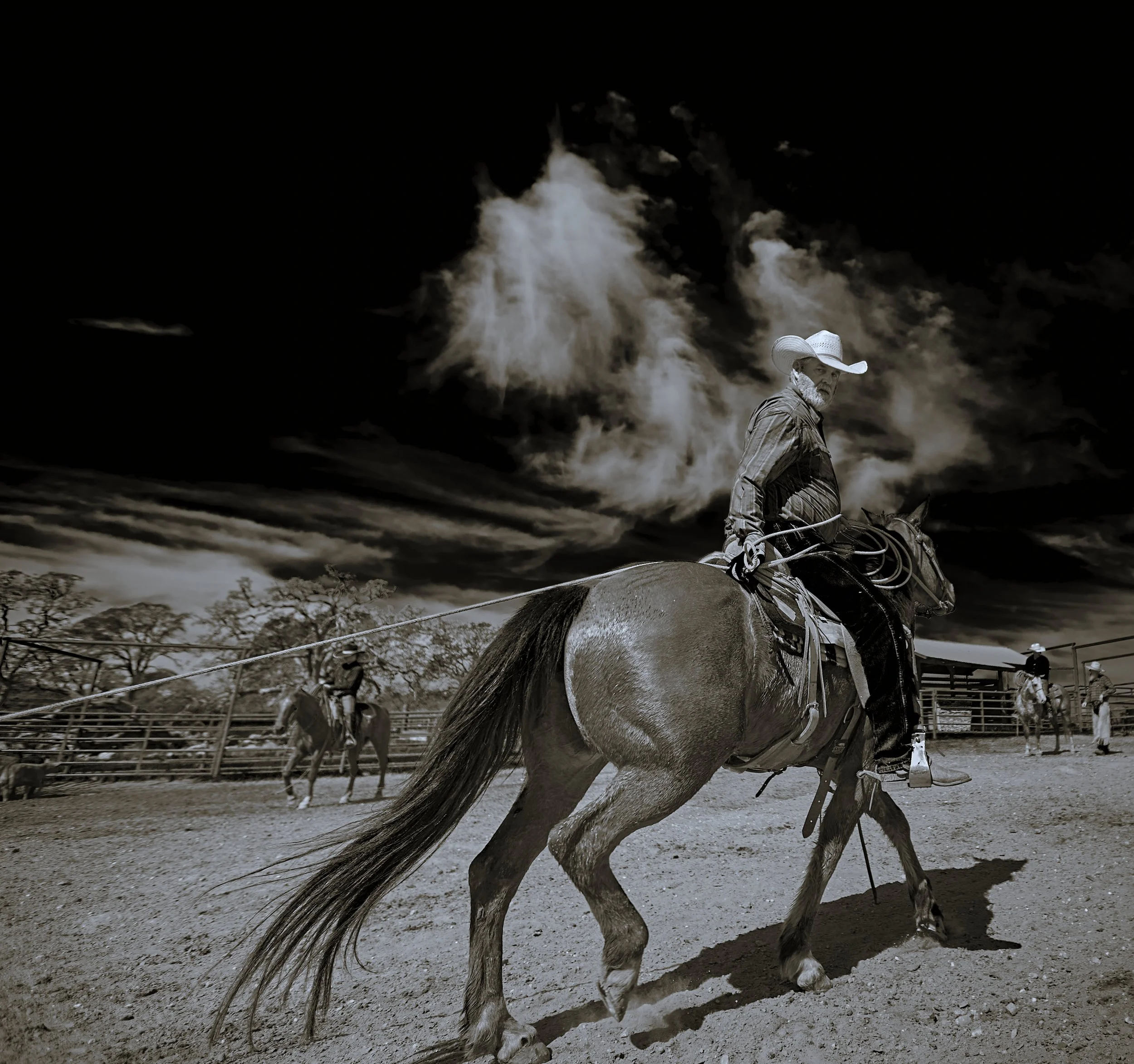
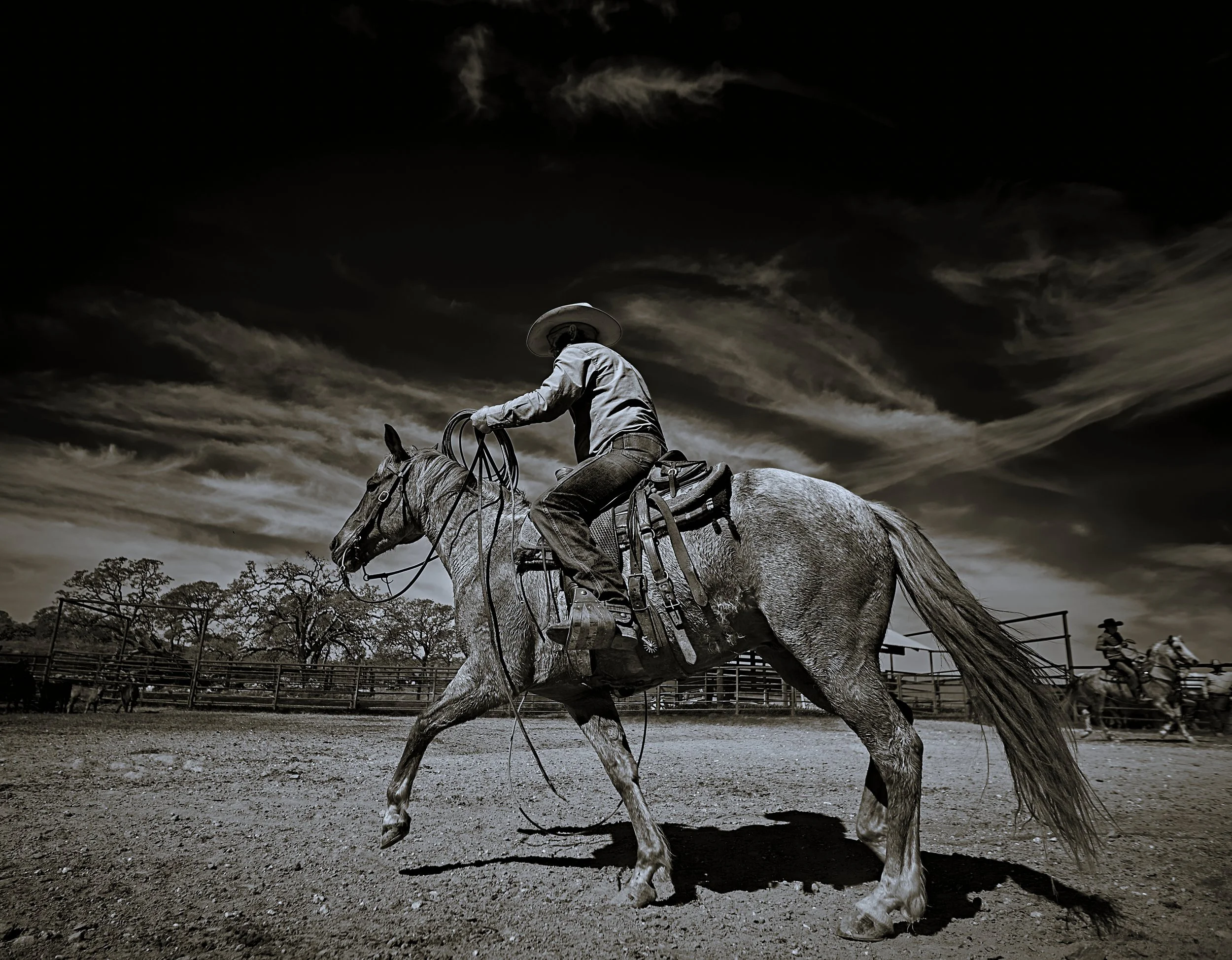
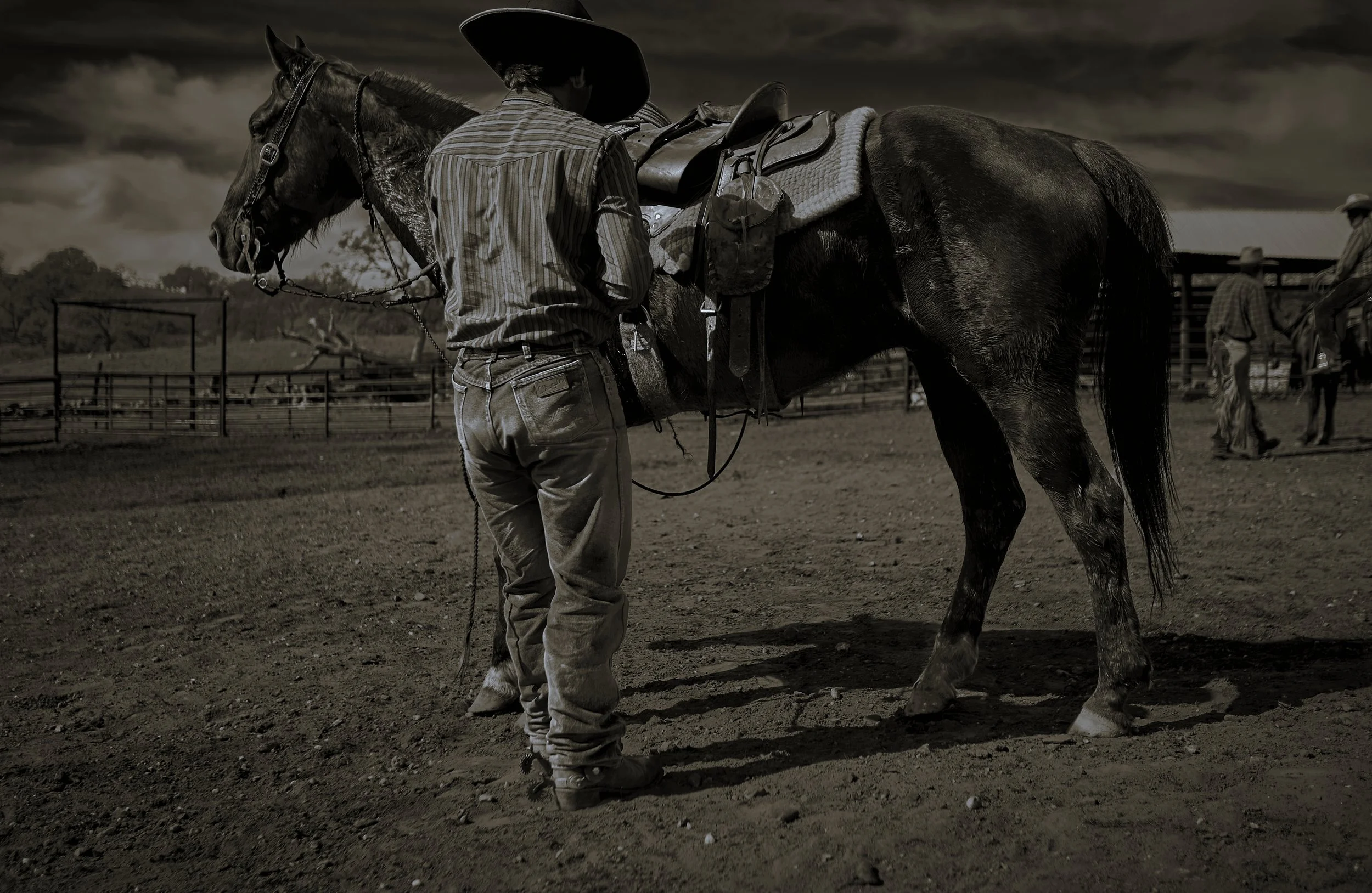
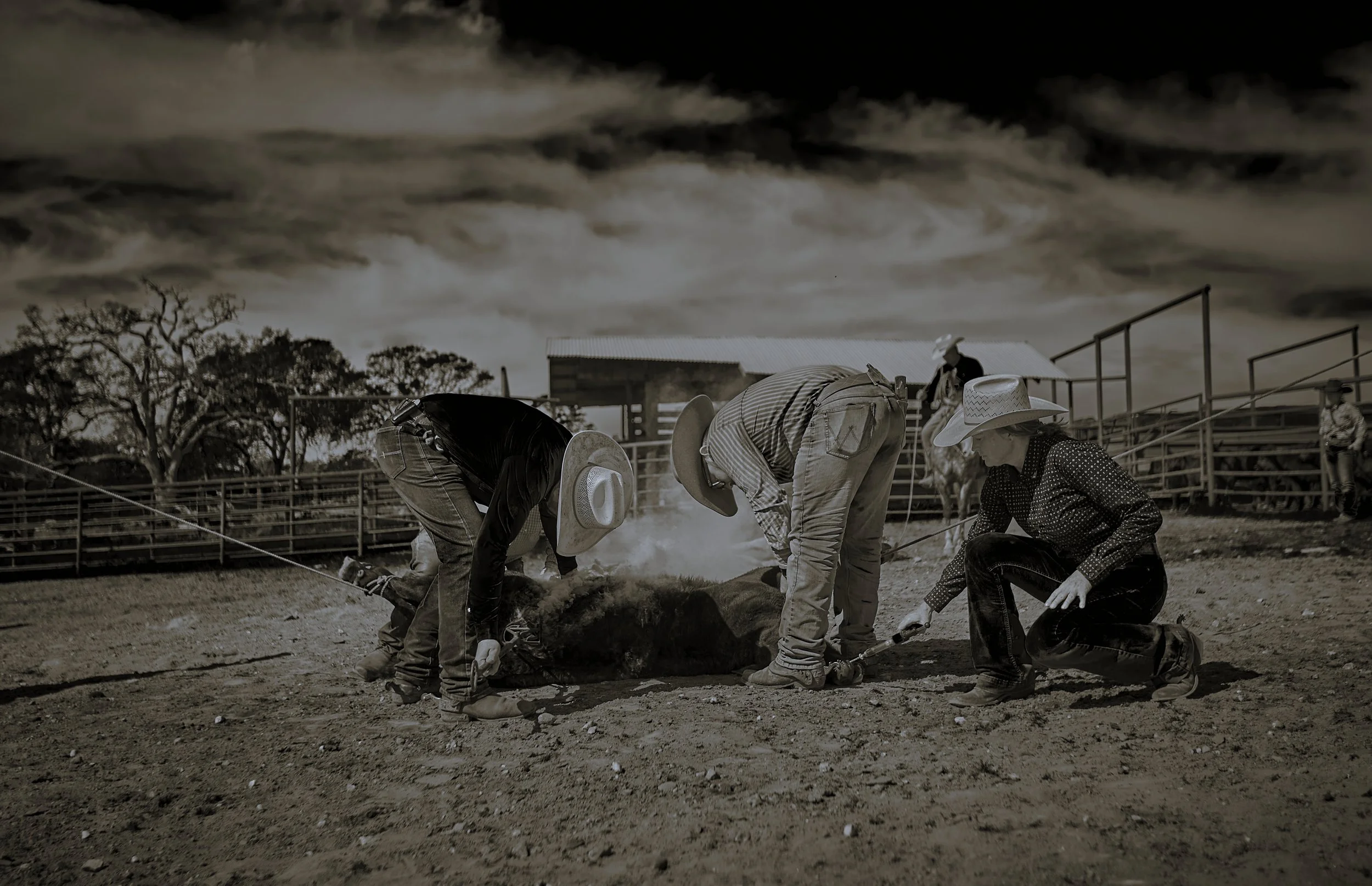
THE WESTERN WAY: A DAY IN THE LIFE OF A CALIFORNIA COWBOY AND HIS CREW
BYLINE
Alyn Robert Brereton was born and raised in cattle country in the foothills of the Sierra Nevada, twenty-three miles east of Modesto, California. The summer he turned sixteen, he worked for a local cattle-ranching family, moving sprinklers in the pasture, repairing fences, and occasionally helping brand calves born that spring during a ranch roundup. That was many years ago. Today, after a multifaceted career as an archaeologist, primatologist, and educator, he is a Professional Rodeo Cowboys Association (PRCA) photographer who travels locally and beyond to capture the fast and furious action of professional rodeo. It is all part of his life in the Western Way.
BLURB
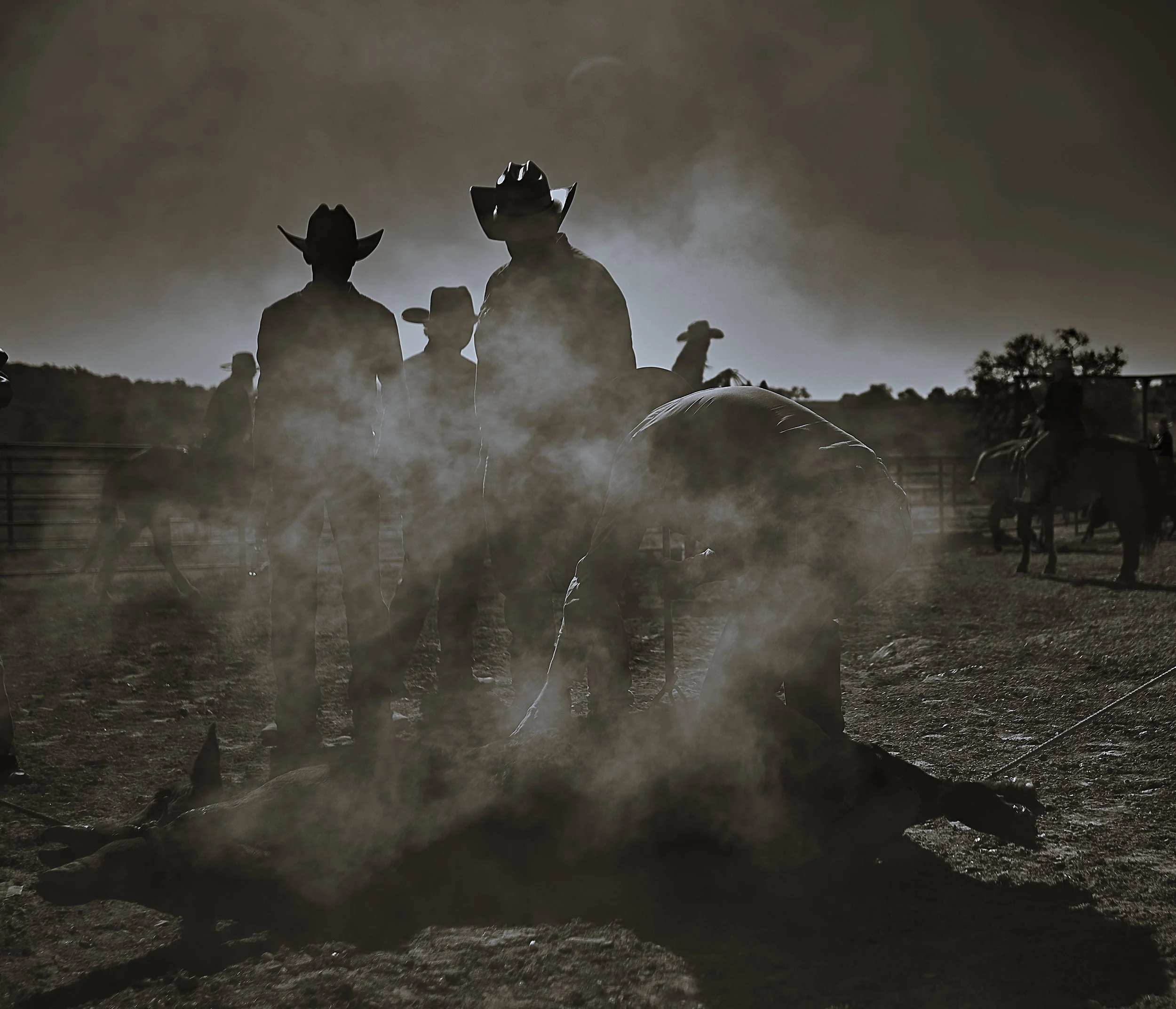
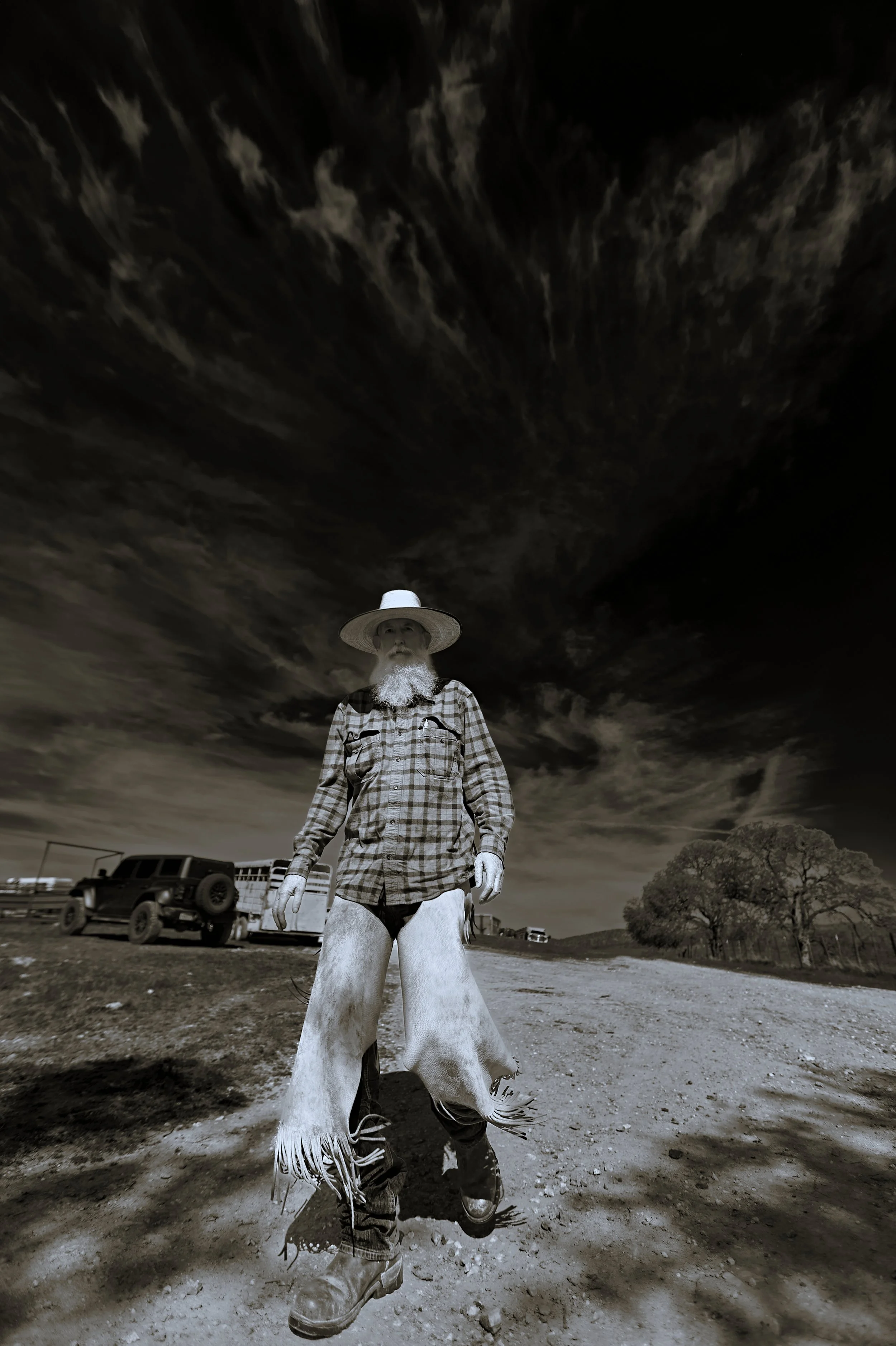
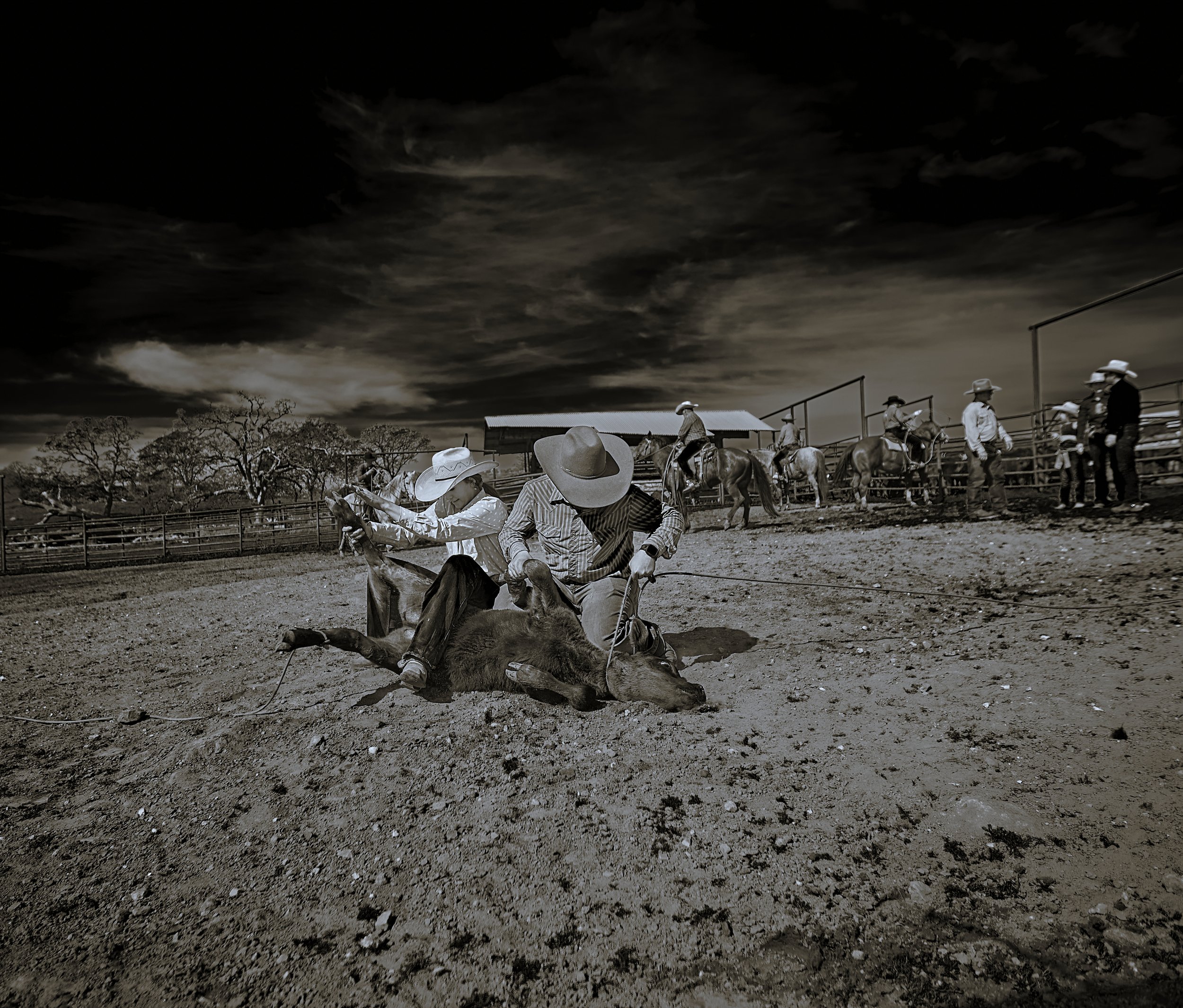
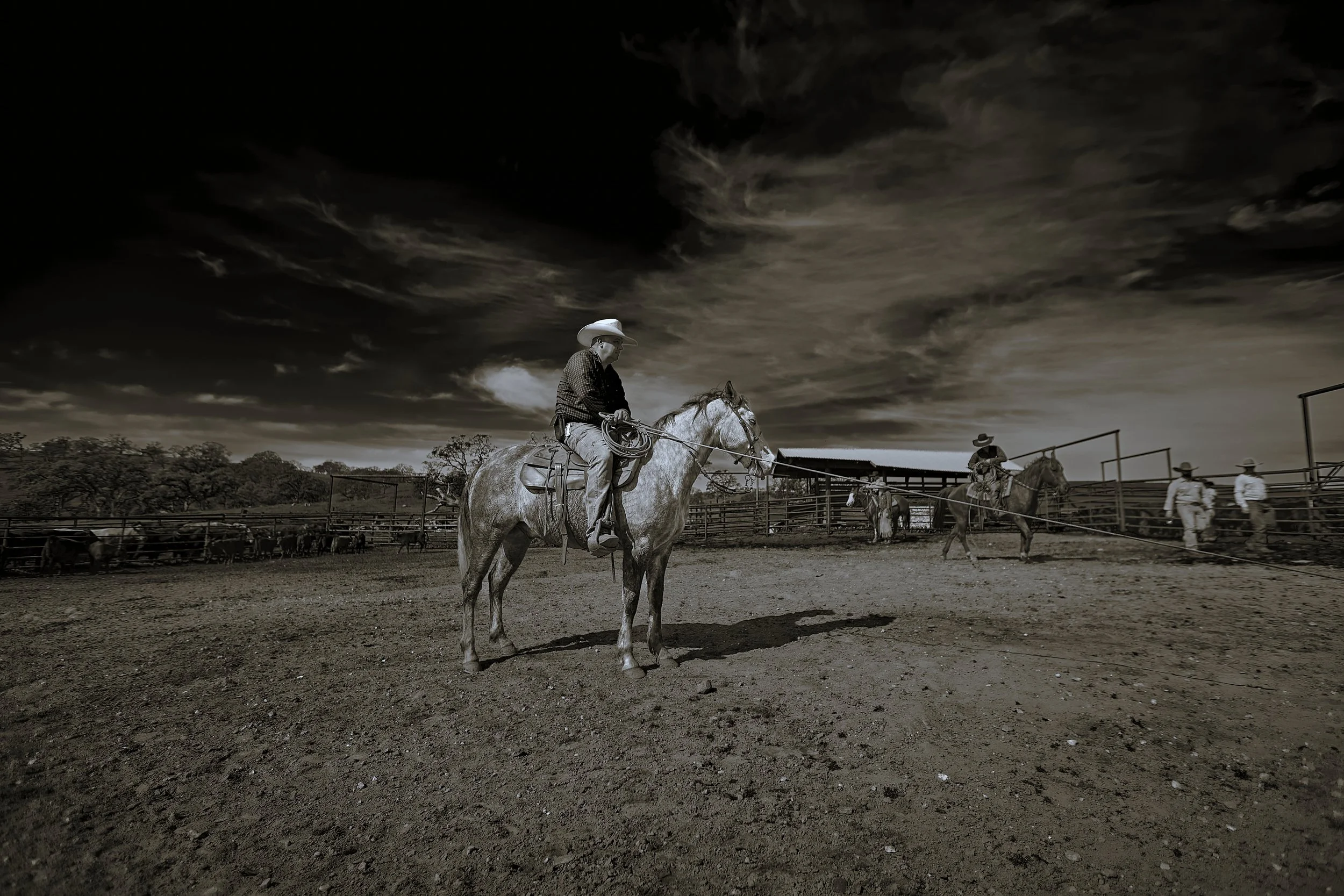
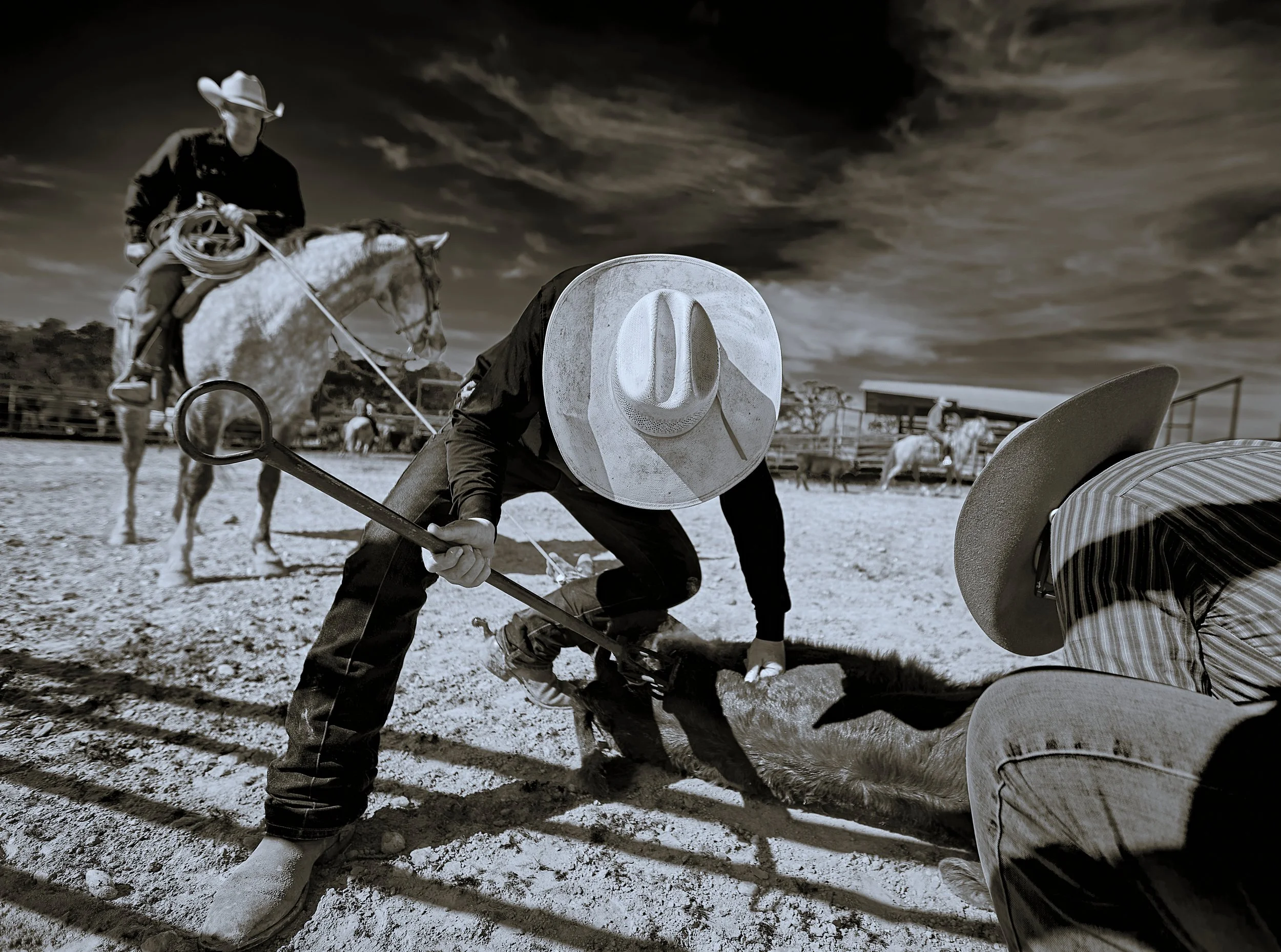
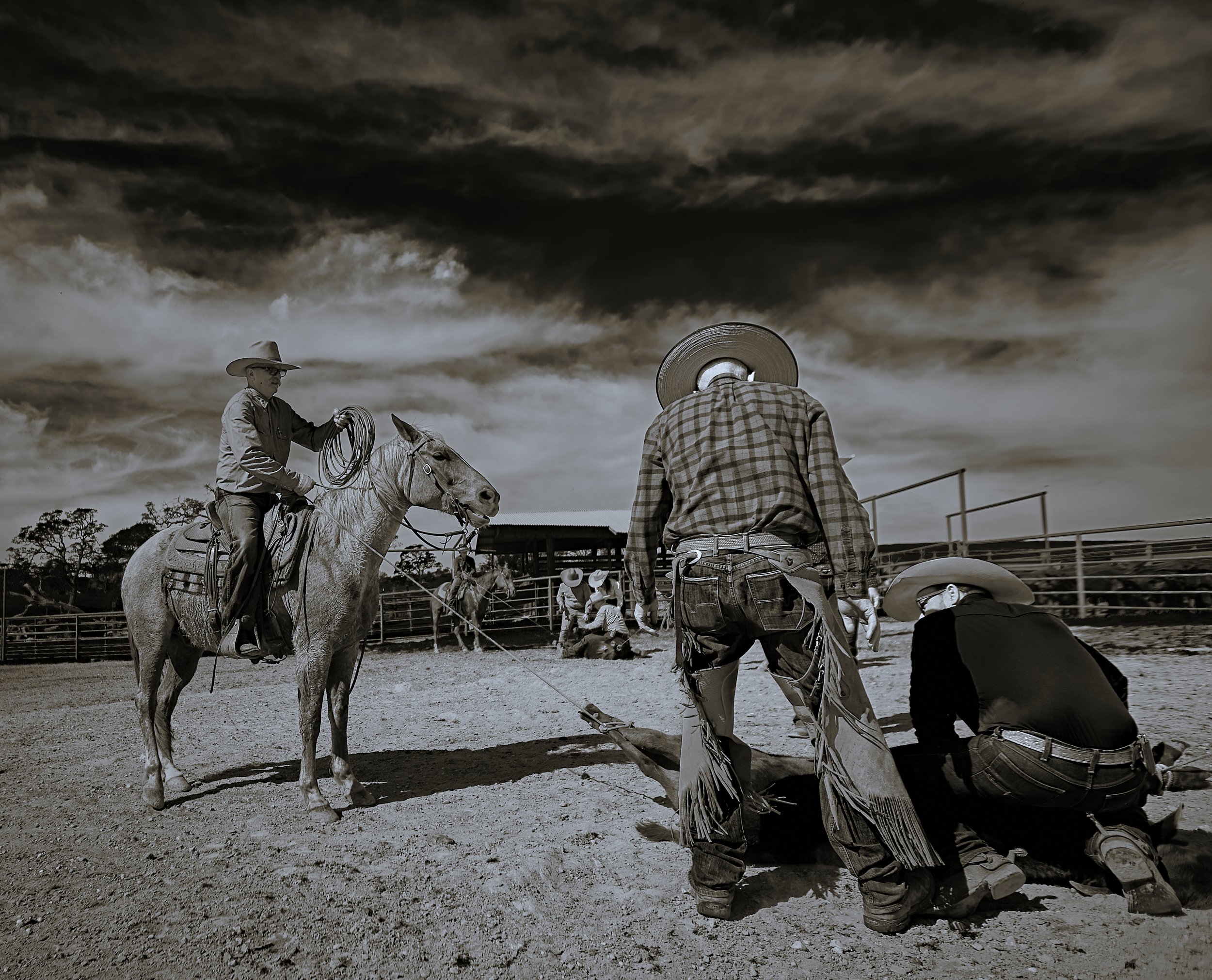
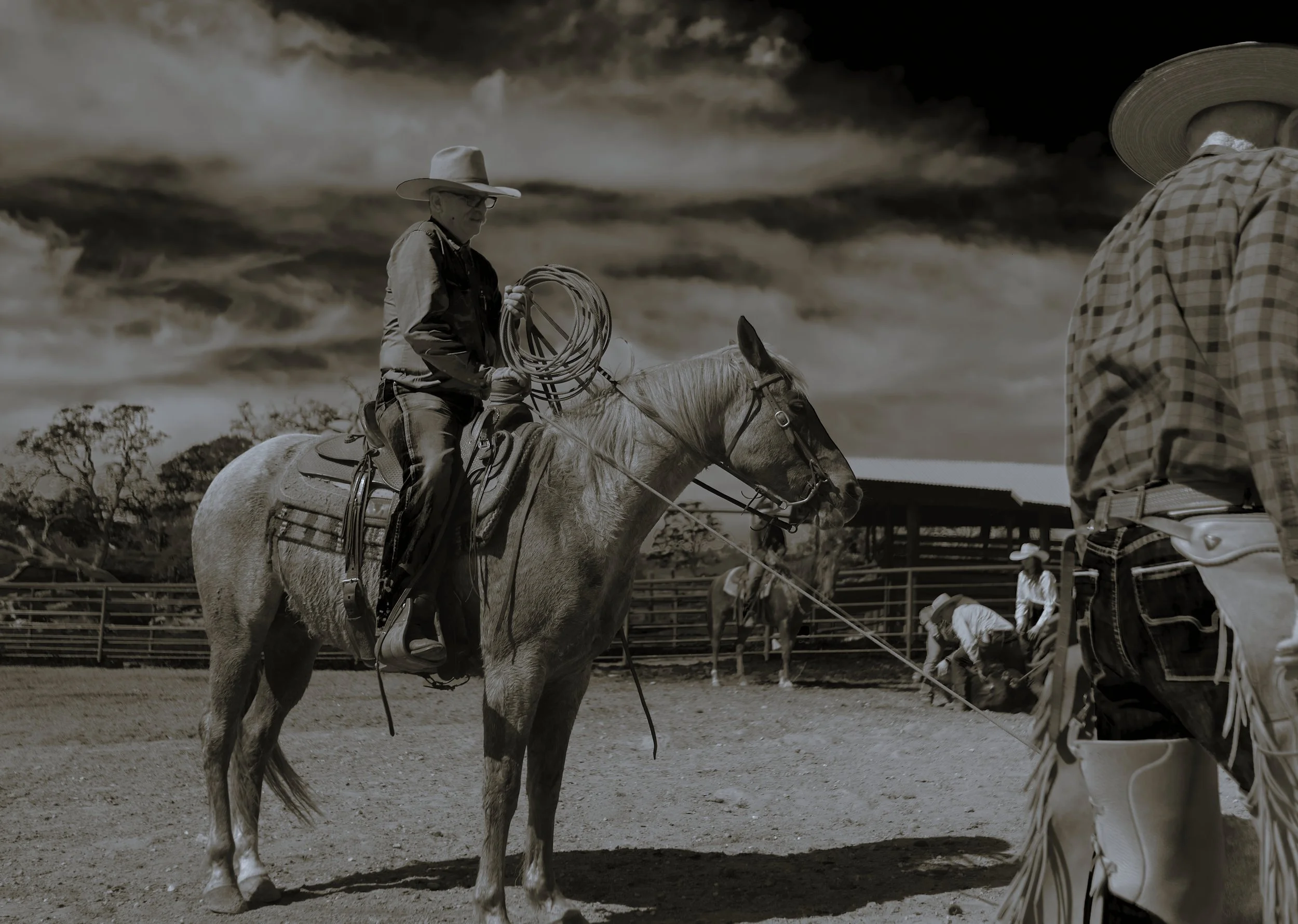
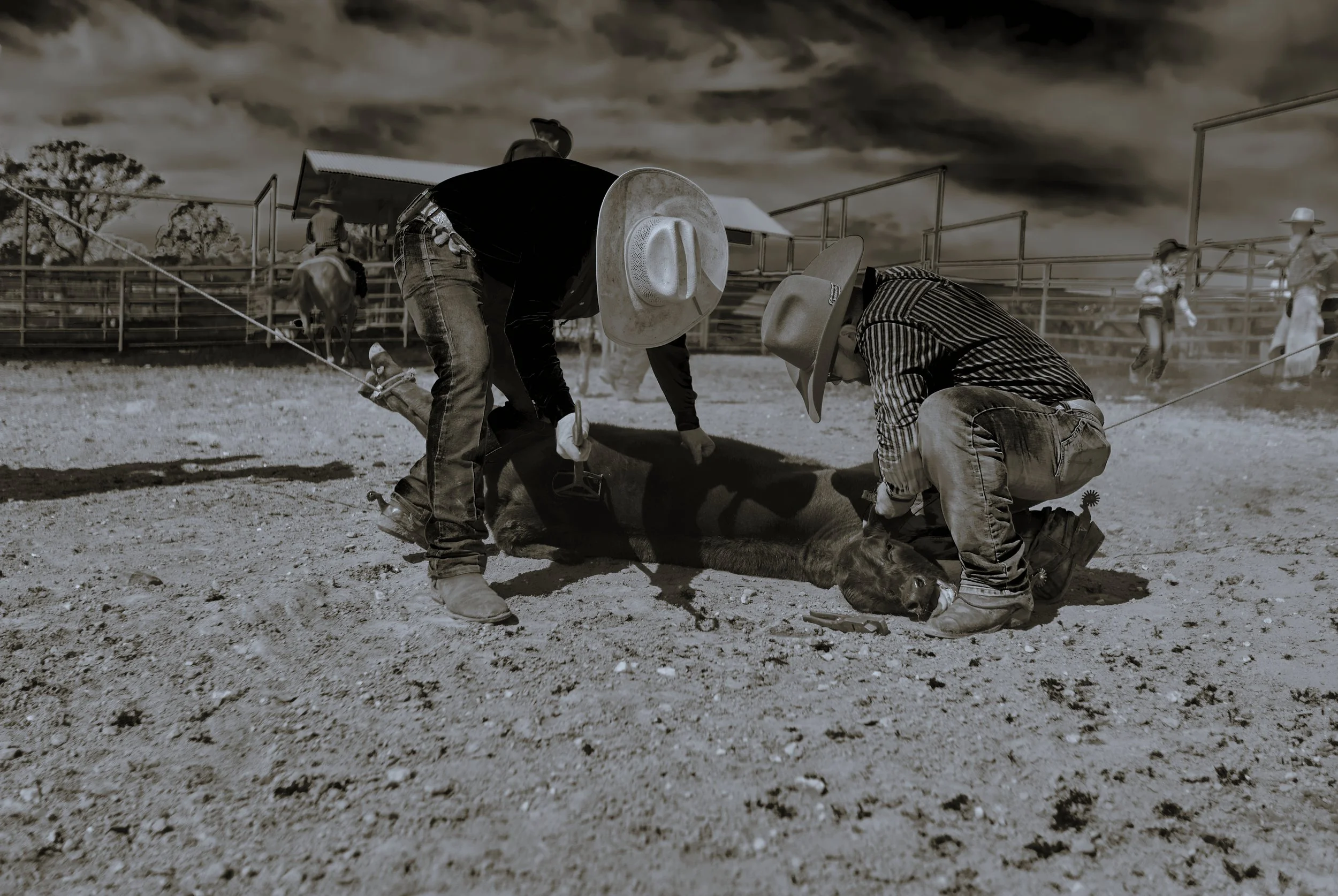
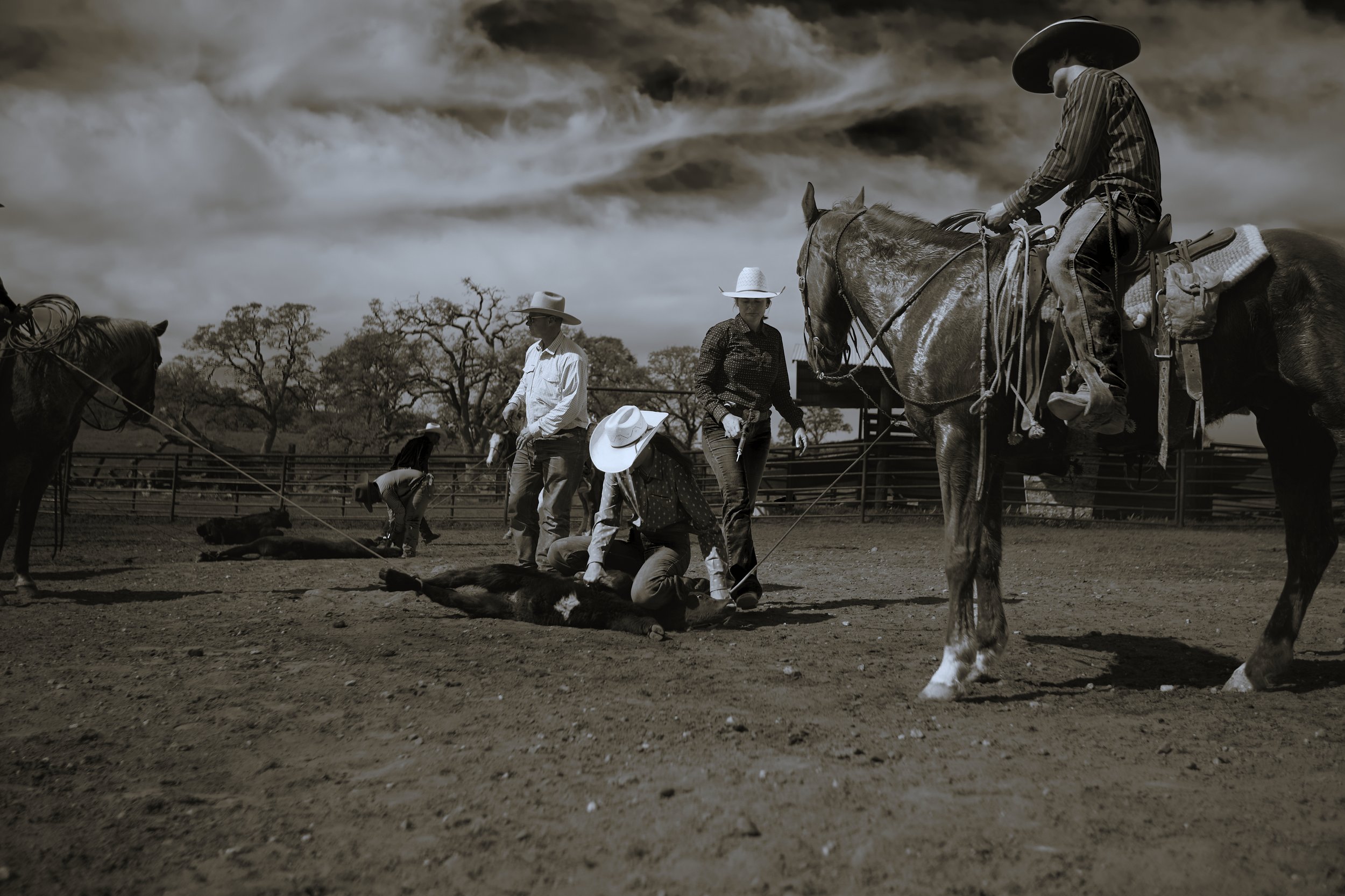
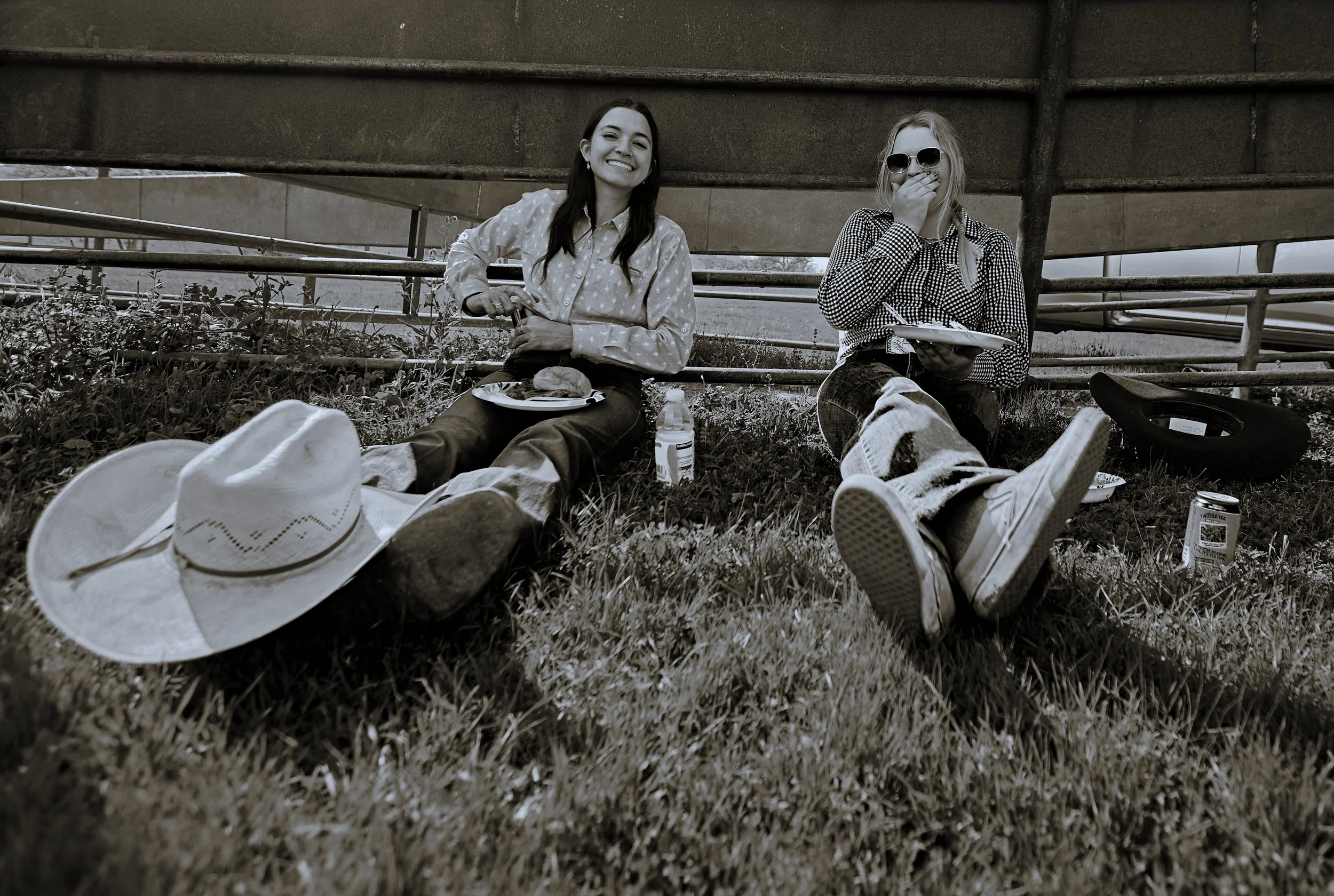
Invited by Scott Heiny, a California cowboy from Escalon, Alyn tells the story of photographing a roundup and branding at Doornenbal Cattle at Church Spring, a ranch located about five miles northeast of Knight’s Ferry. The event took place on February 28, 2026, from early morning through midafternoon, followed by a cowboy-style lunch of steaks cooked on the grill, beans simmered in a pot, and sweets for dessert.
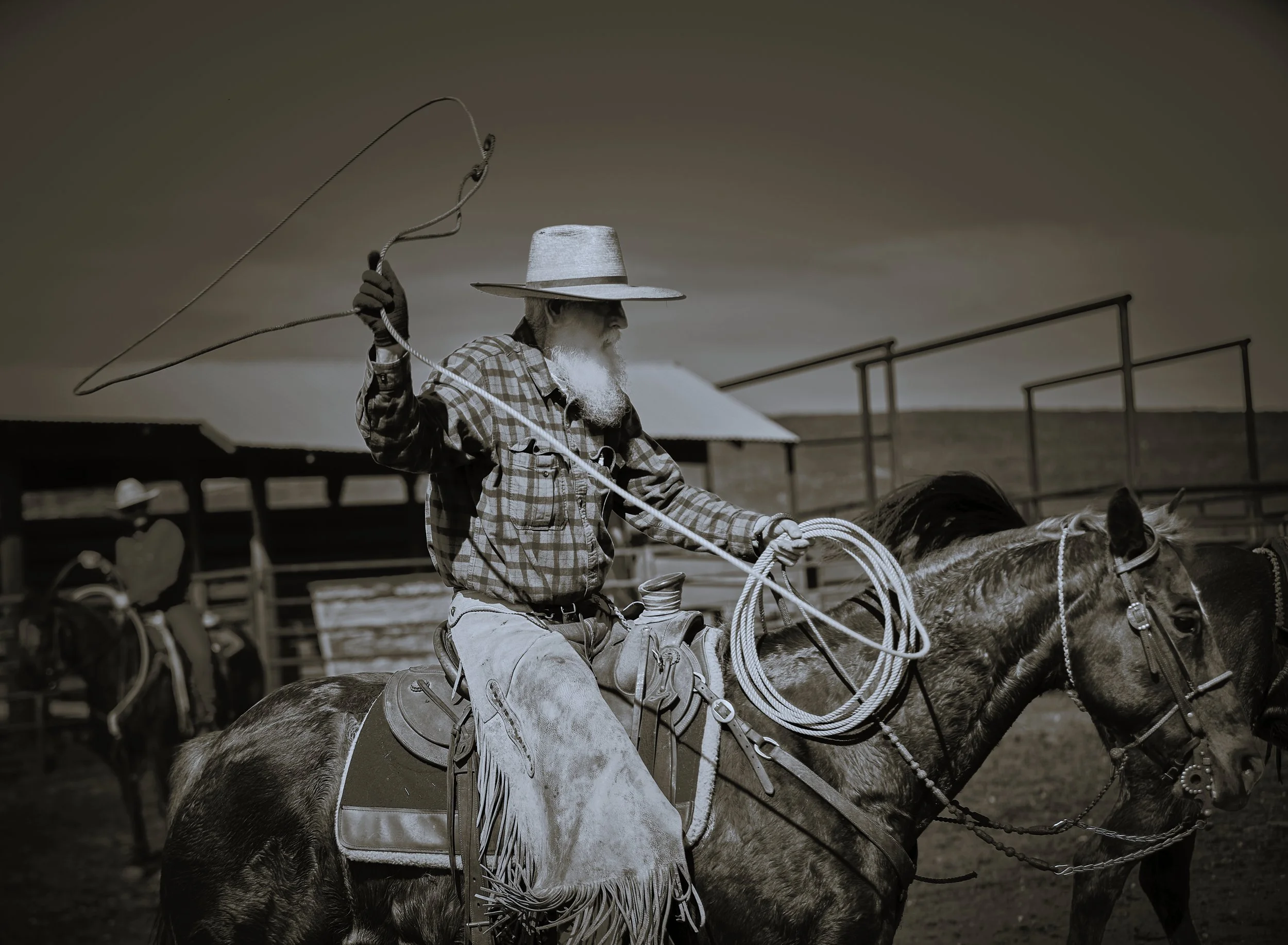
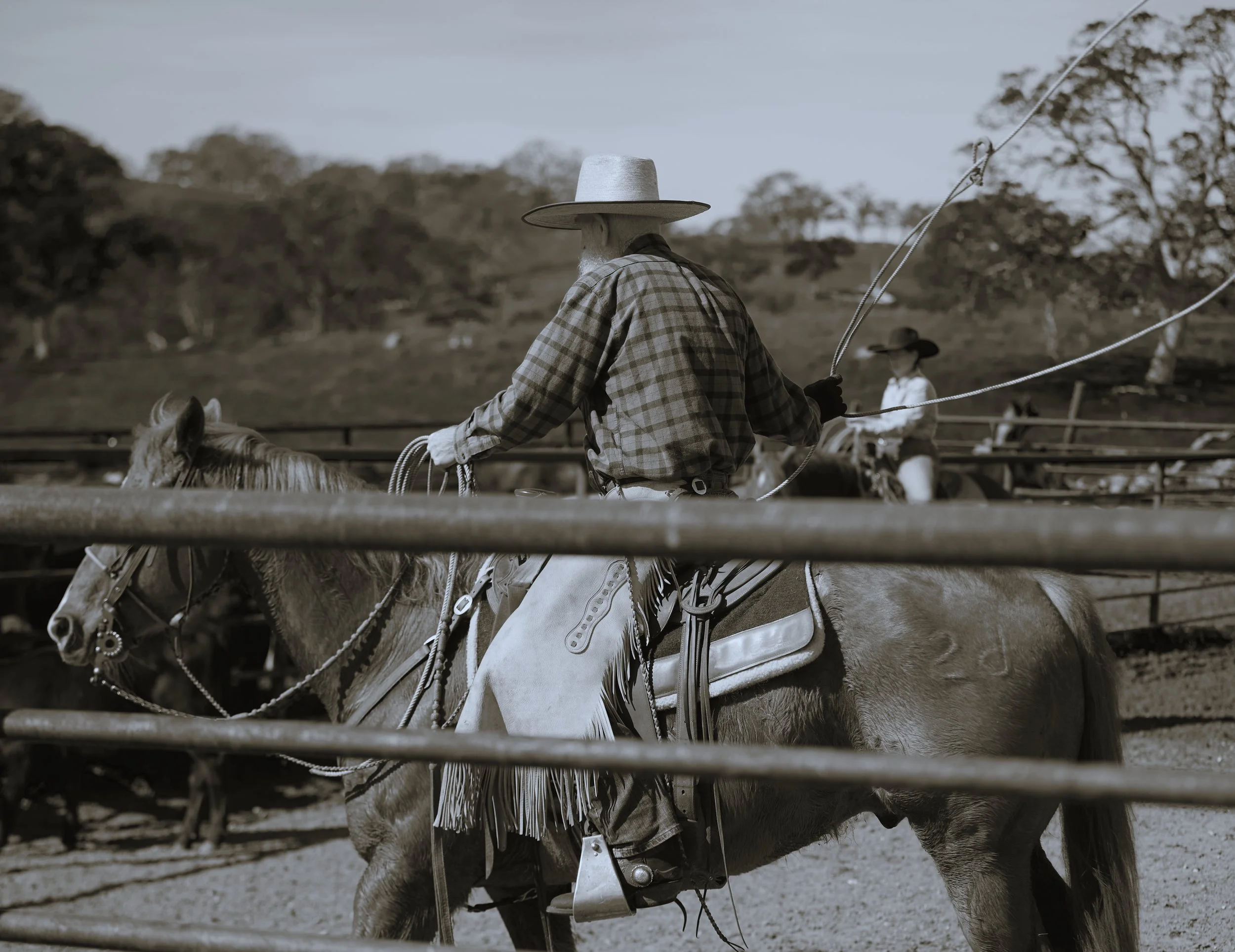
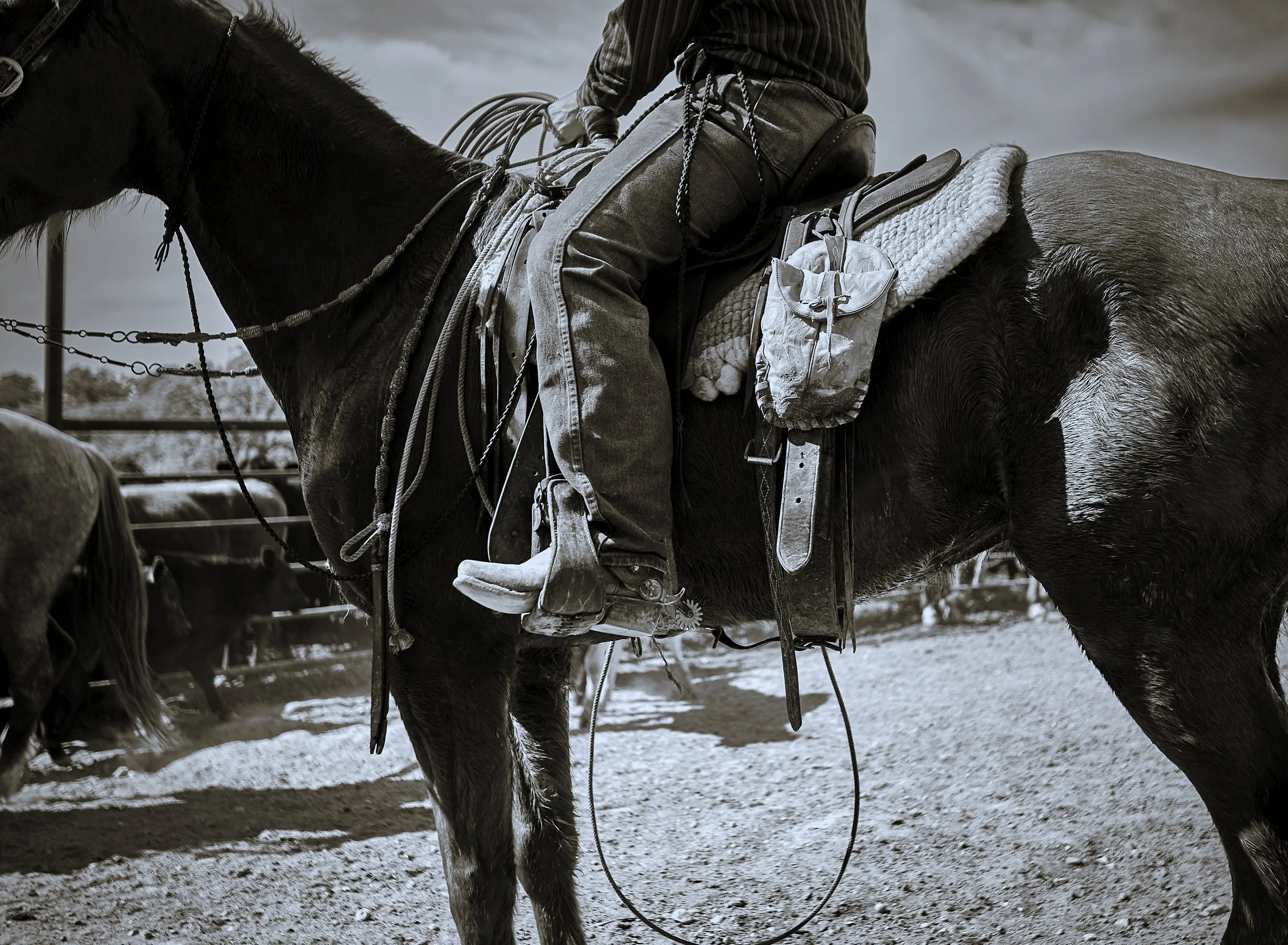
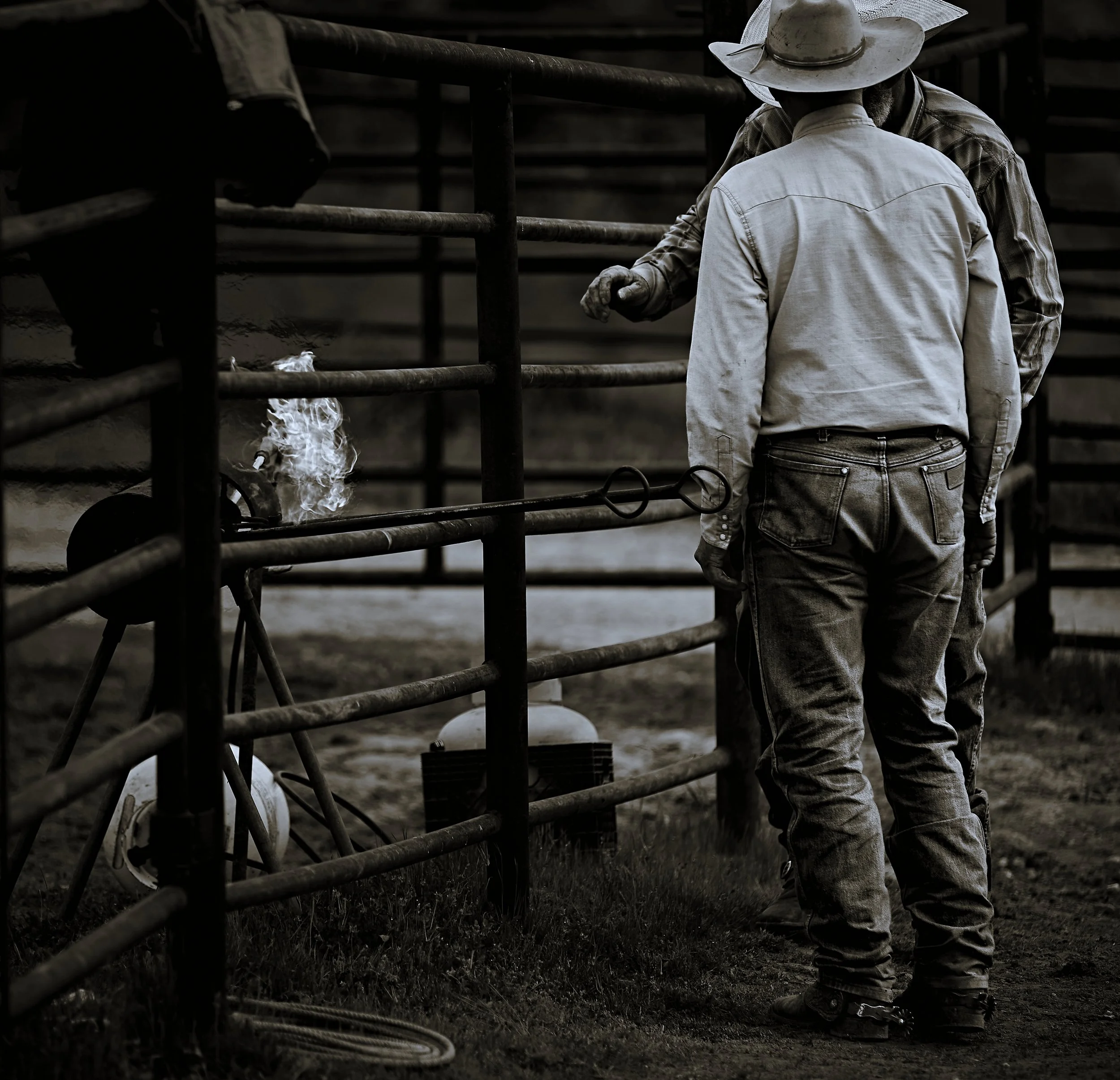
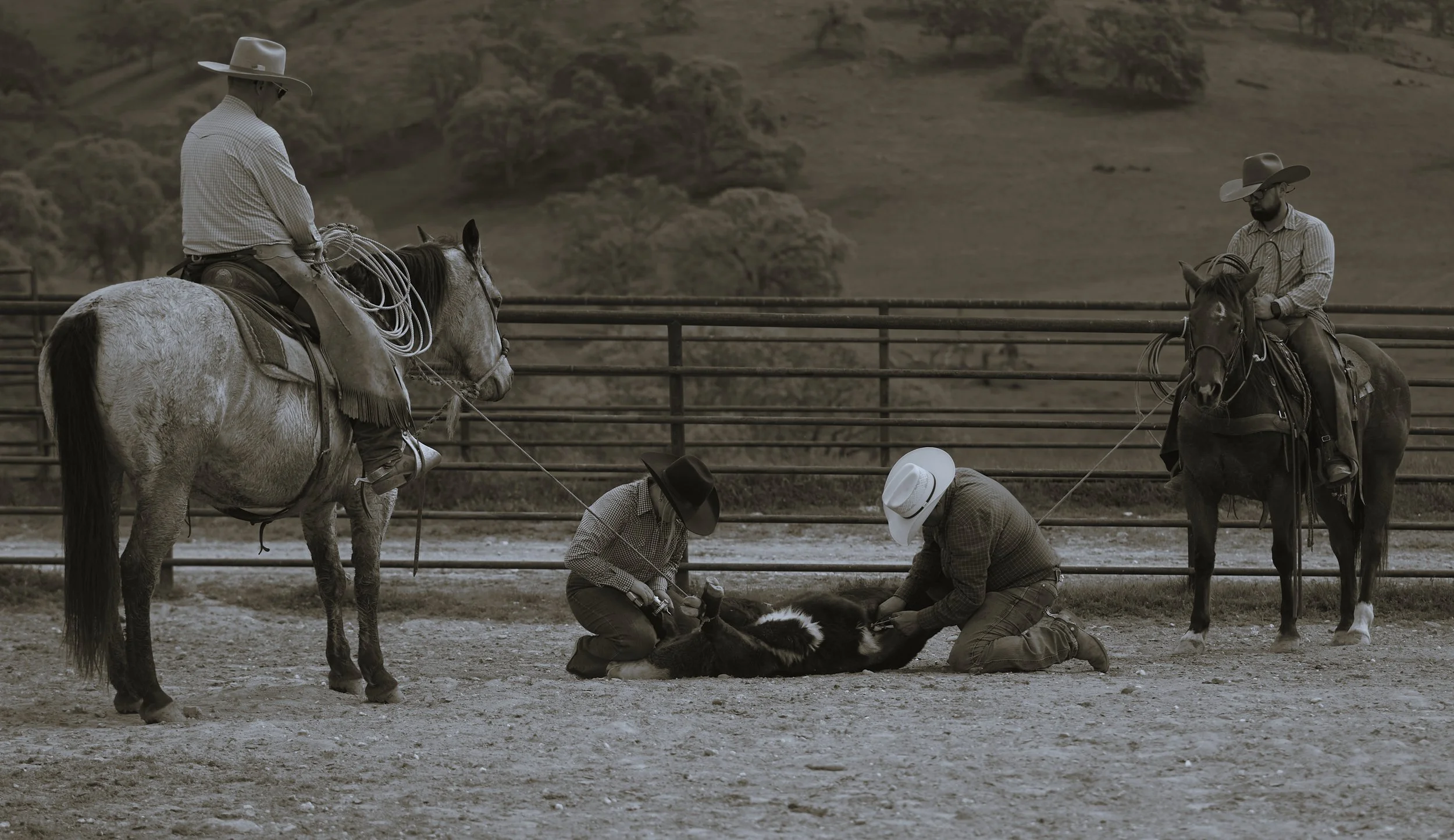
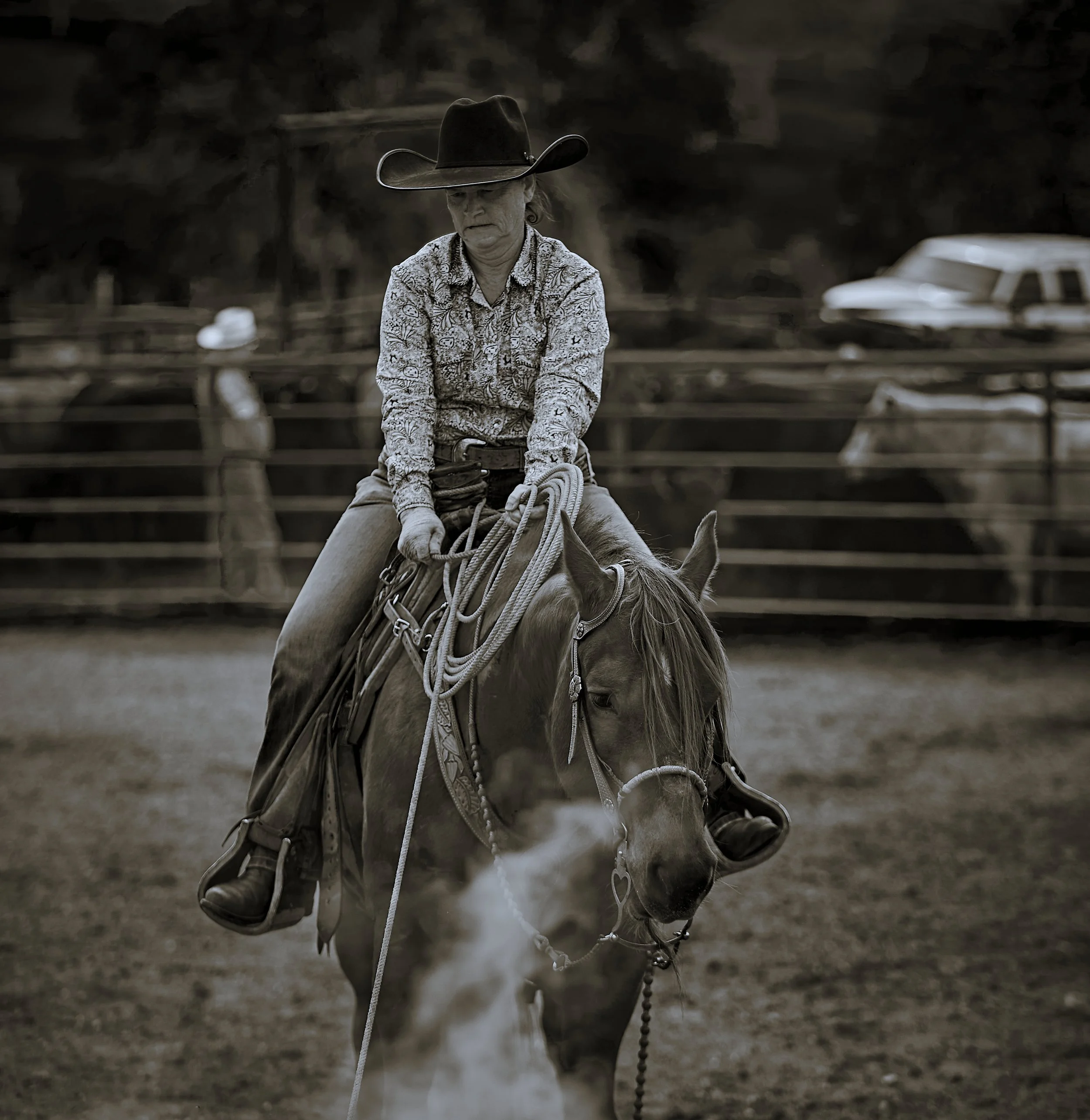
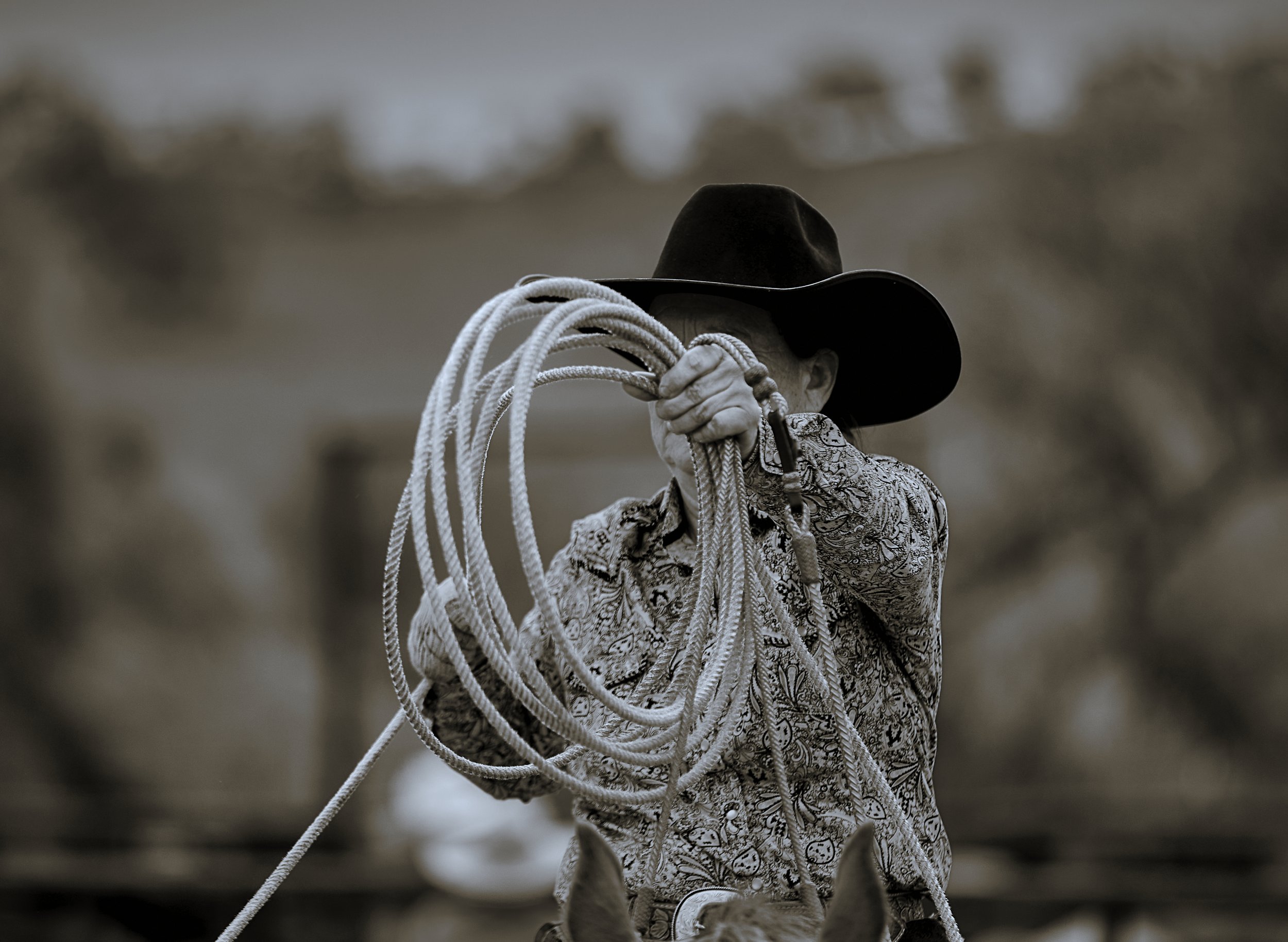
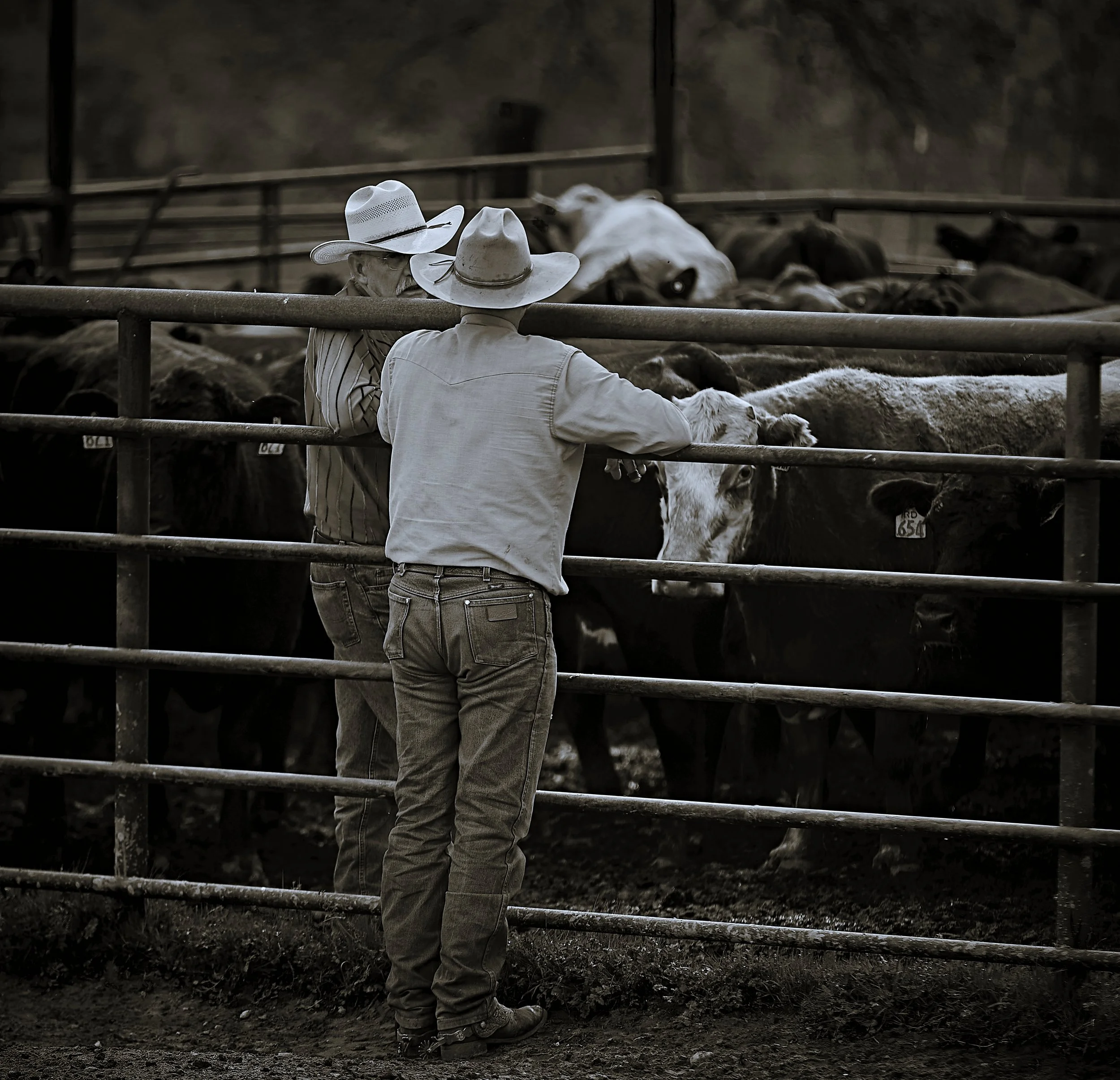
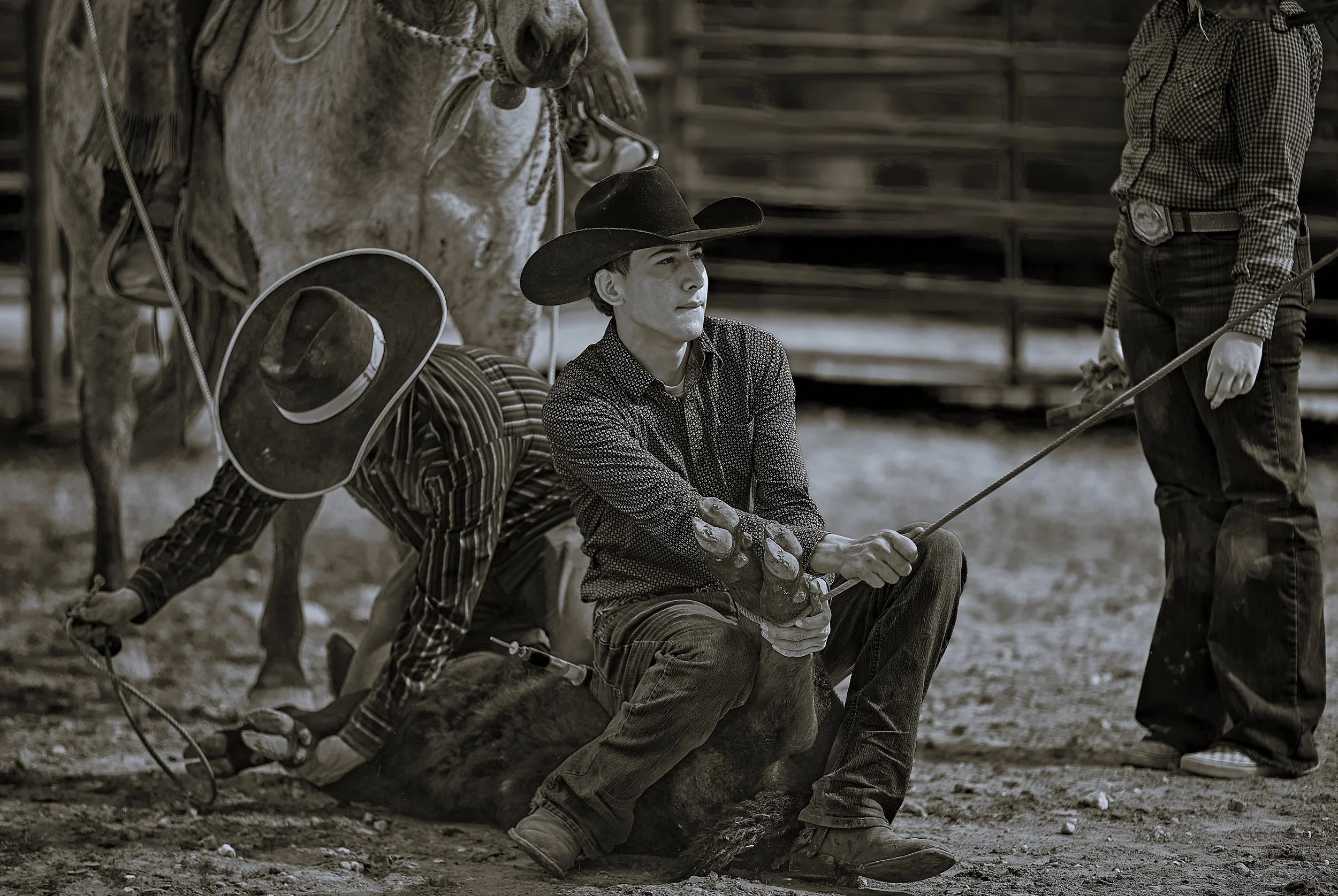
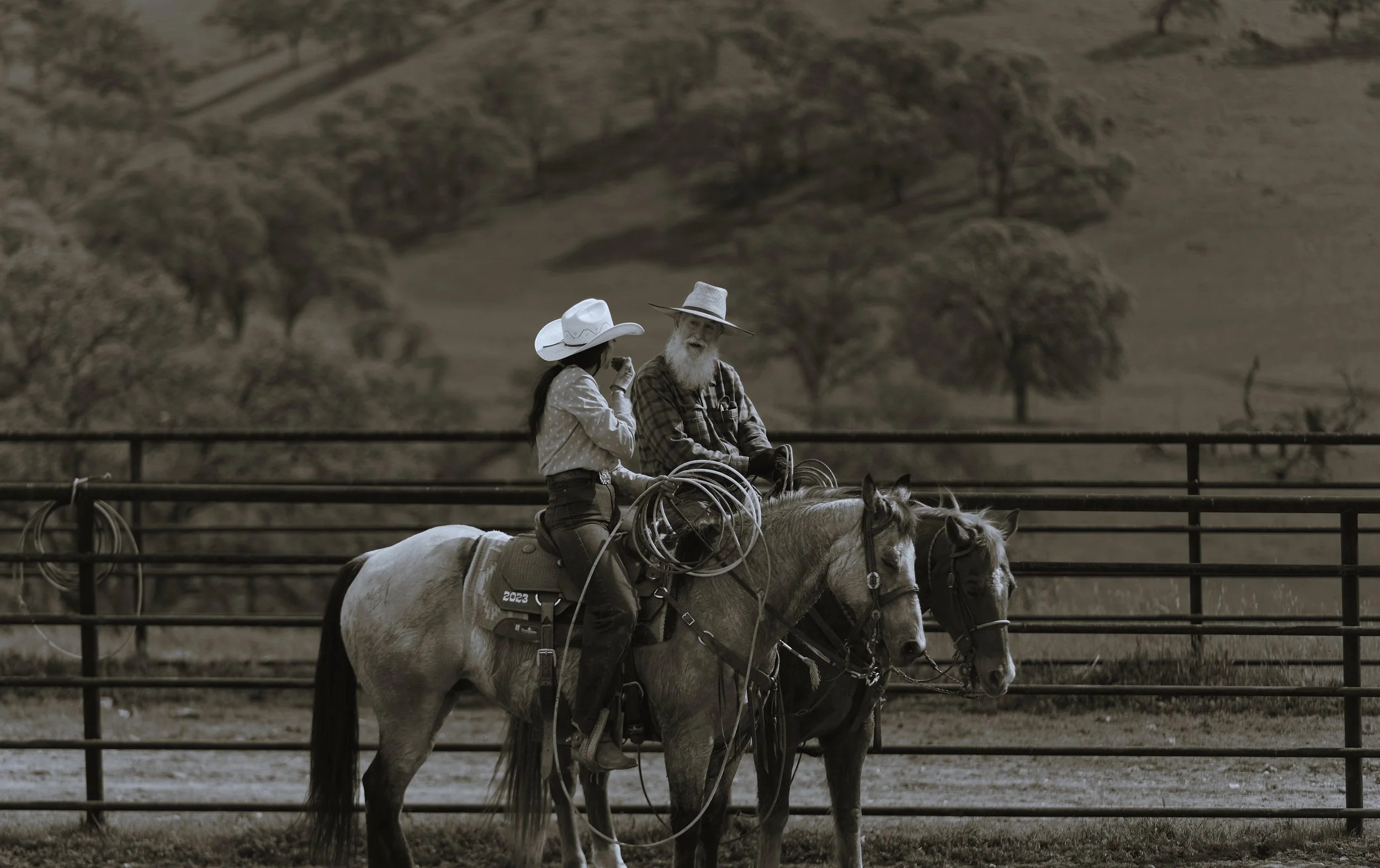
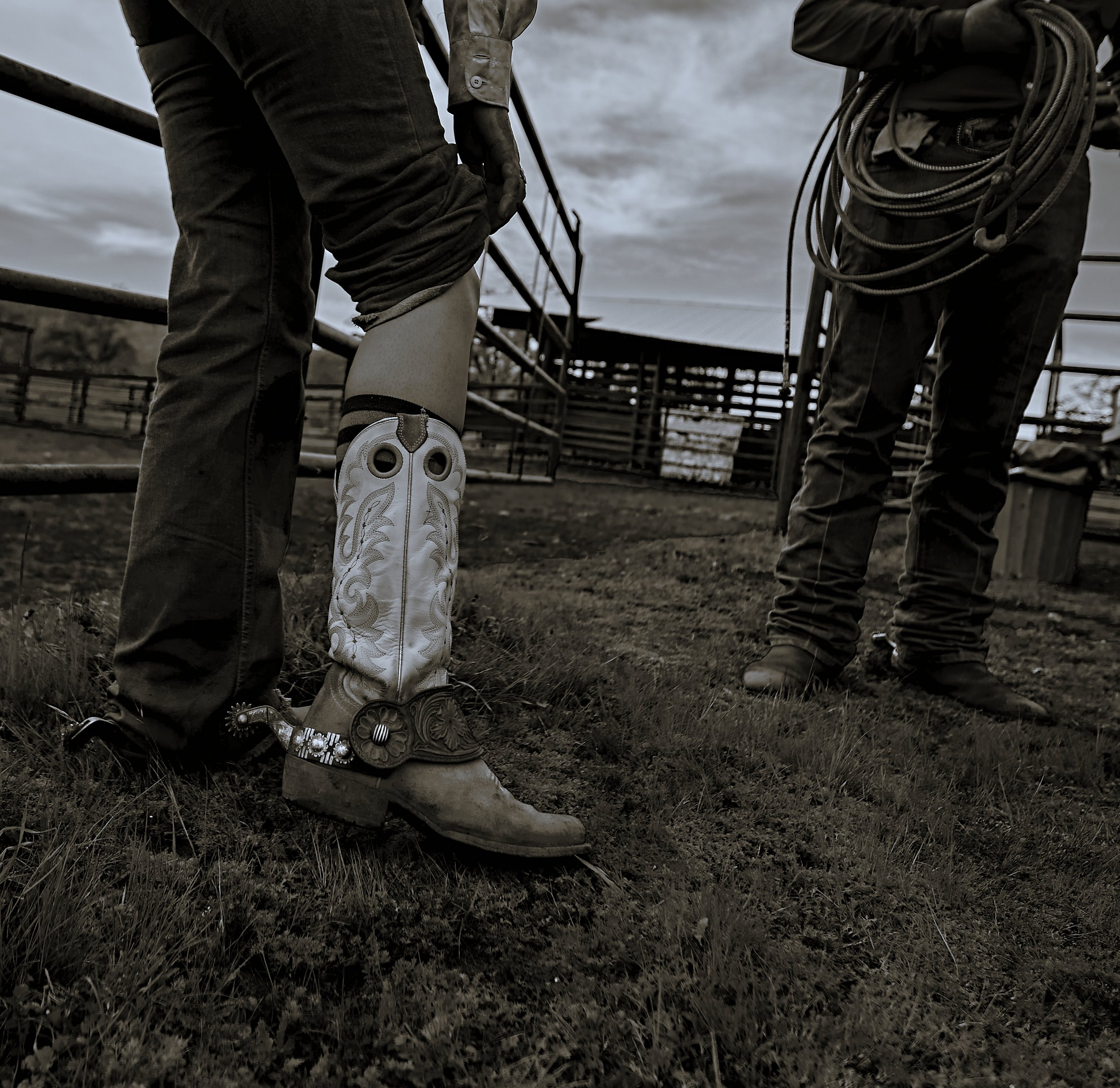
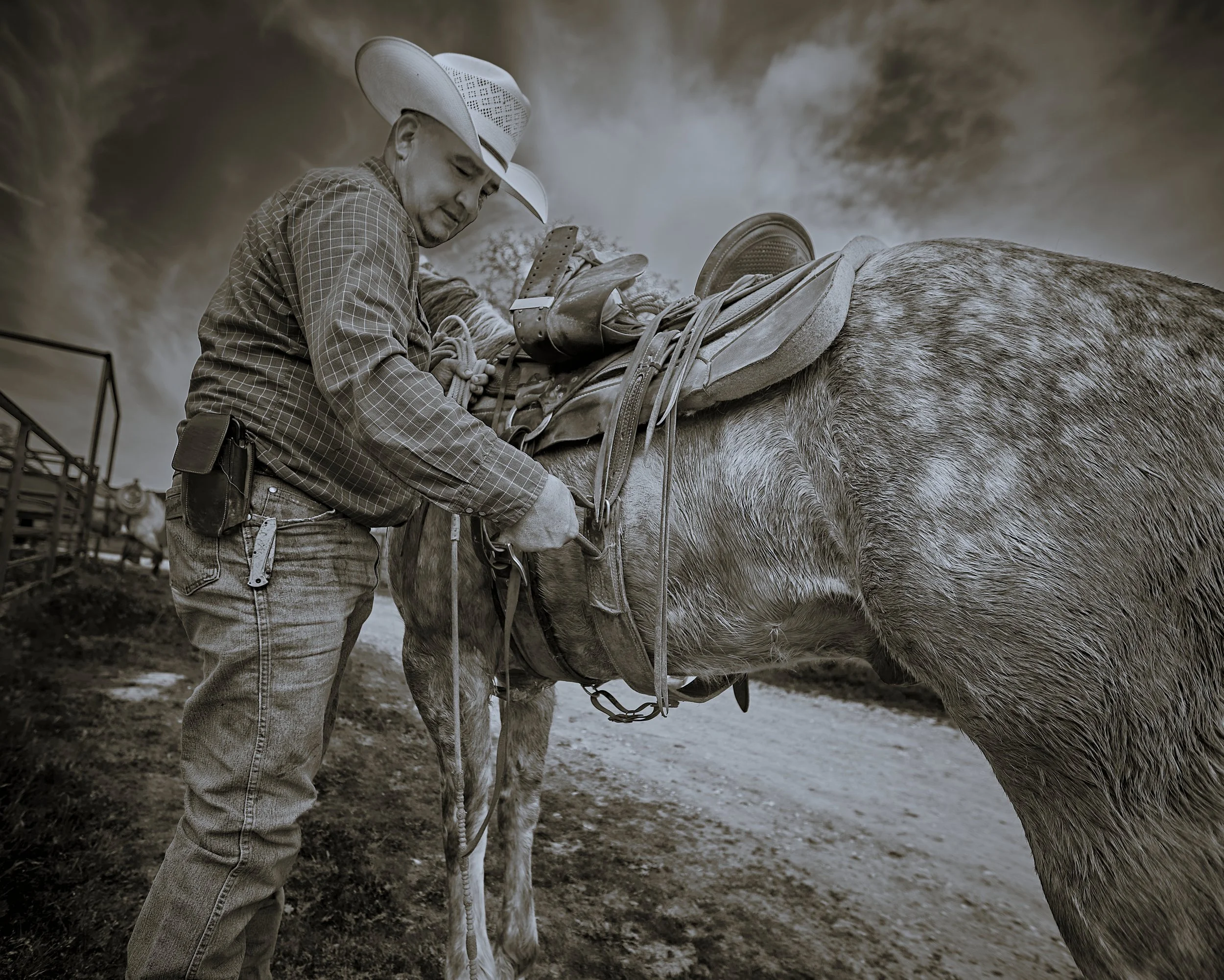
In other words, this is a partial documentation of what cowboys and cowgirls do every day: work the ranch, take care of business, and carry on a proud and traditional lifestyle that Western cattle-ranching families have lived for more than a century. This is the real-world cowboy and cowgirl way of the all-American West.
THE WESTERN WAY
It is early morning—6:15 a.m. on February 28, 2026. Alyn awakens and eats a quick breakfast: oatmeal. Old-Fashioned Quaker Oats, the slow-cooking kind, is the breakfast he has eaten since childhood. It is what his father, Robert Young, cooked for him and his three brothers before they headed off by bus—or, on occasion, by bicycle—to the two-room elementary school at Roberts Ferry, three miles away along the Tuolumne River.
This is cowboy country. Back then, the school had no more than thirty-five students, spanning first through eighth grades, with two teachers, a husband and wife. It was a close-knit community made up of cattle, grain, and dairy-ranching families living within an eight-mile radius. There was no town, just a building and a playground—the epicenter of all community activity.
After breakfast, Alyn dresses, cowboy style: Twisted X slip-on boots, traditional Wrangler jeans, a light-blue denim snap-down cowboy shirt, a wild rag (bandana) around his neck, and an American Hat Company straw cowboy hat. You know—the ordinary, everyday cowboy attire similar to what working cowboys and cowgirls wear in their daily lives.
Alyn is not an everyday cowboy, though. He is a storyteller and photographer who documents the real lives of cowboys and cowgirls as they go about their working days.
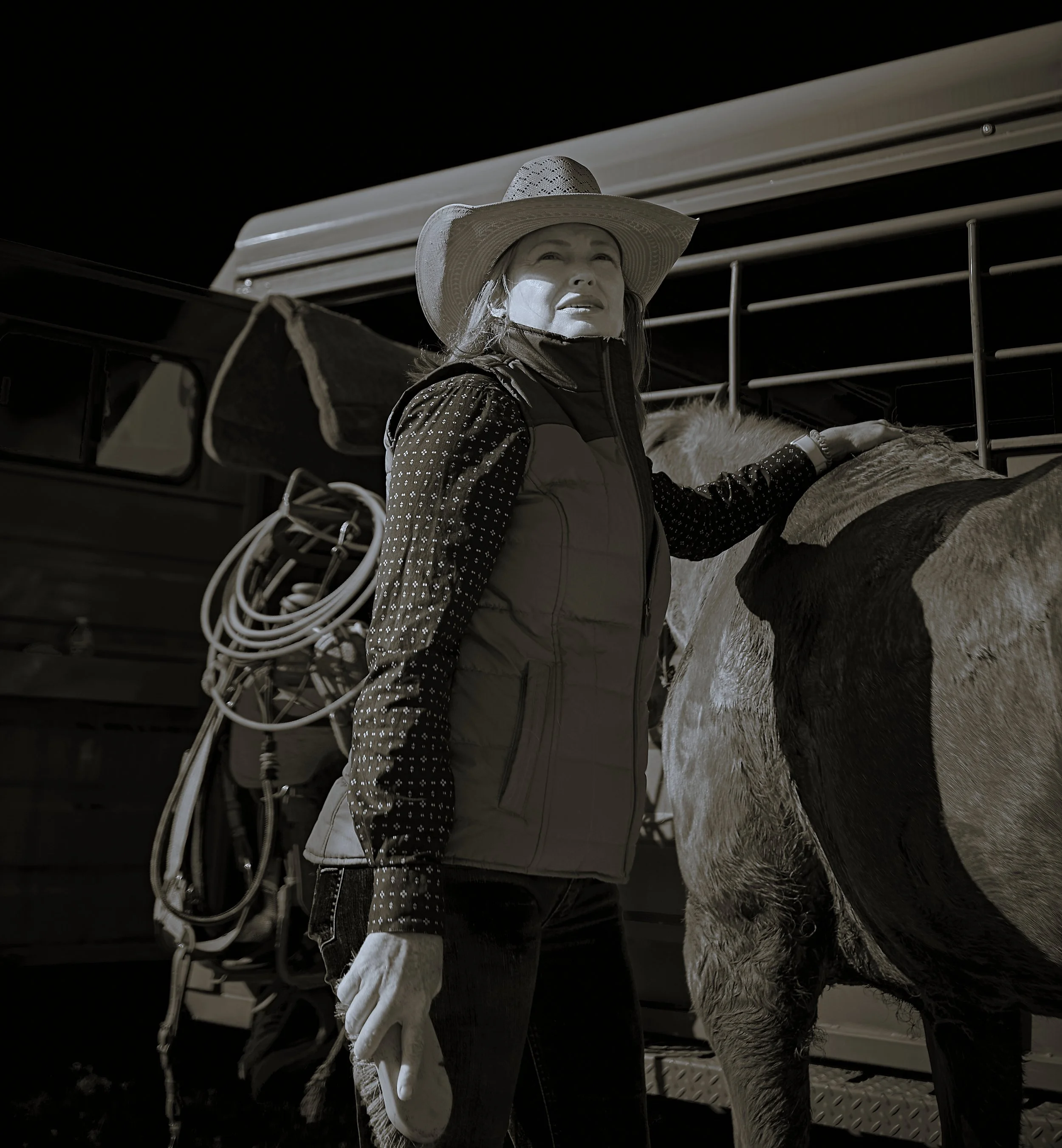
To “prove” that Alyn is not a true working cowboy, he drives a Tesla Model Y Performance—not the vehicle cattle ranchers normally use for their daily work. They drive pickup trucks—Fords, Chevys, and Dodge Rams—and pull long horse trailers large enough to carry their tack and their most valuable partners and working assets: their horses. A cattle rancher cannot operate without well-trained equine companions. Horses are what make cowboys cowboys and cowgirls cowgirls.
With his trusted camera gear onboard, Alyn sets off, heading northeast in his Tesla from Modesto, where he lives with his wife, Kris, whom he has known since childhood, and their two cats, Sam and Tigre. He travels through Oakdale and continues along Highway 120 toward Knight’s Ferry.
Highway 120 is the route that leads from the San Francisco Bay Area to Yosemite National Park. If you have never been to Yosemite, you must go. It is a magical American natural wonder, a mecca for nature lovers and rock-climbing enthusiasts from around the world. Kris and Alyn have traveled to and hiked in Yosemite many dozens of times over the years.
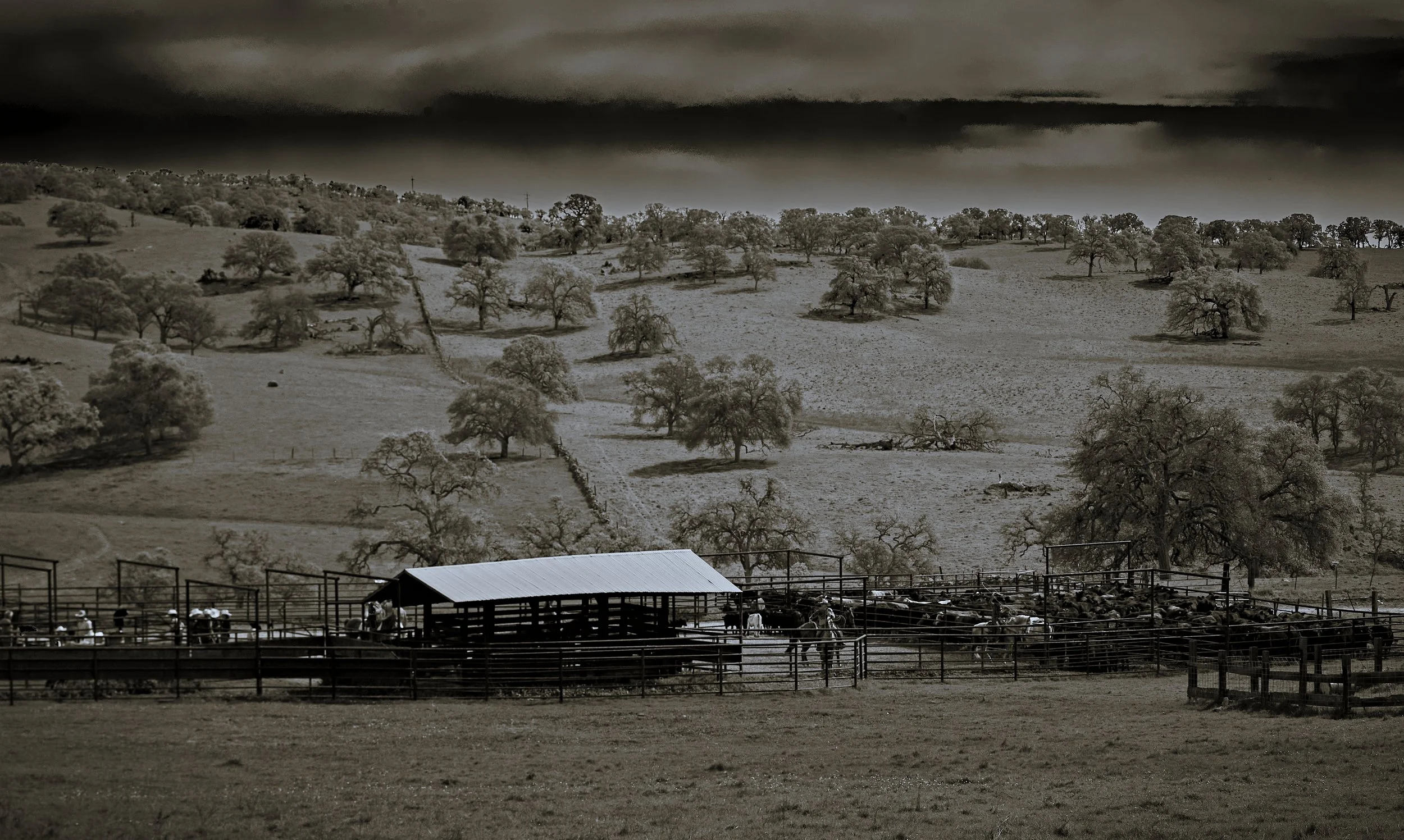
On this journey, however, Alyn turns off Highway 120 just east of Oakdale onto Orange Blossom Road, driving north-northeast for several miles to Sonora Road. Once on Sonora Road, he travels another couple of miles to an iron gate on the right, just past a ranch house along a creek in open country of rolling grassland hills dotted with oak trees.
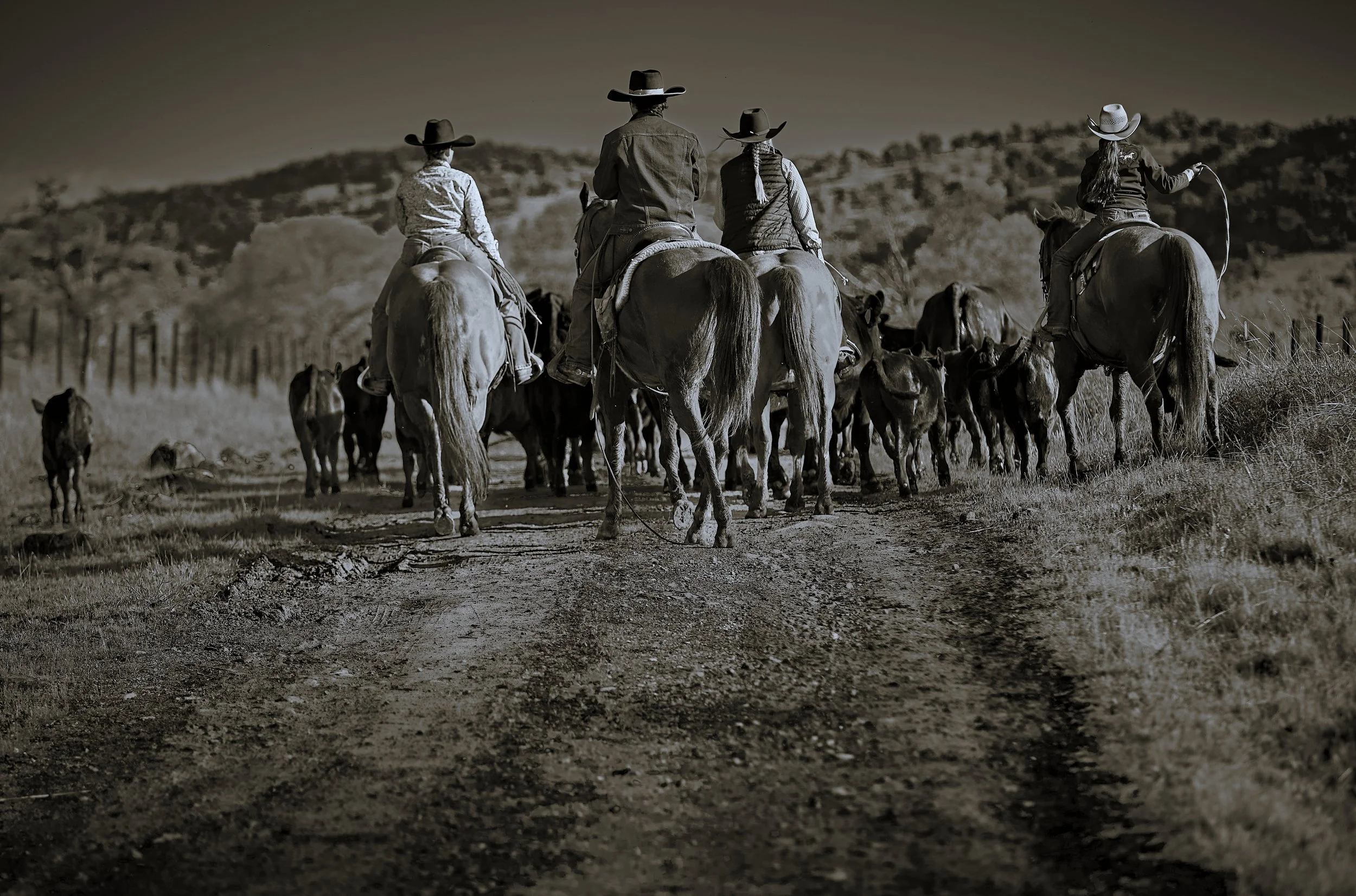
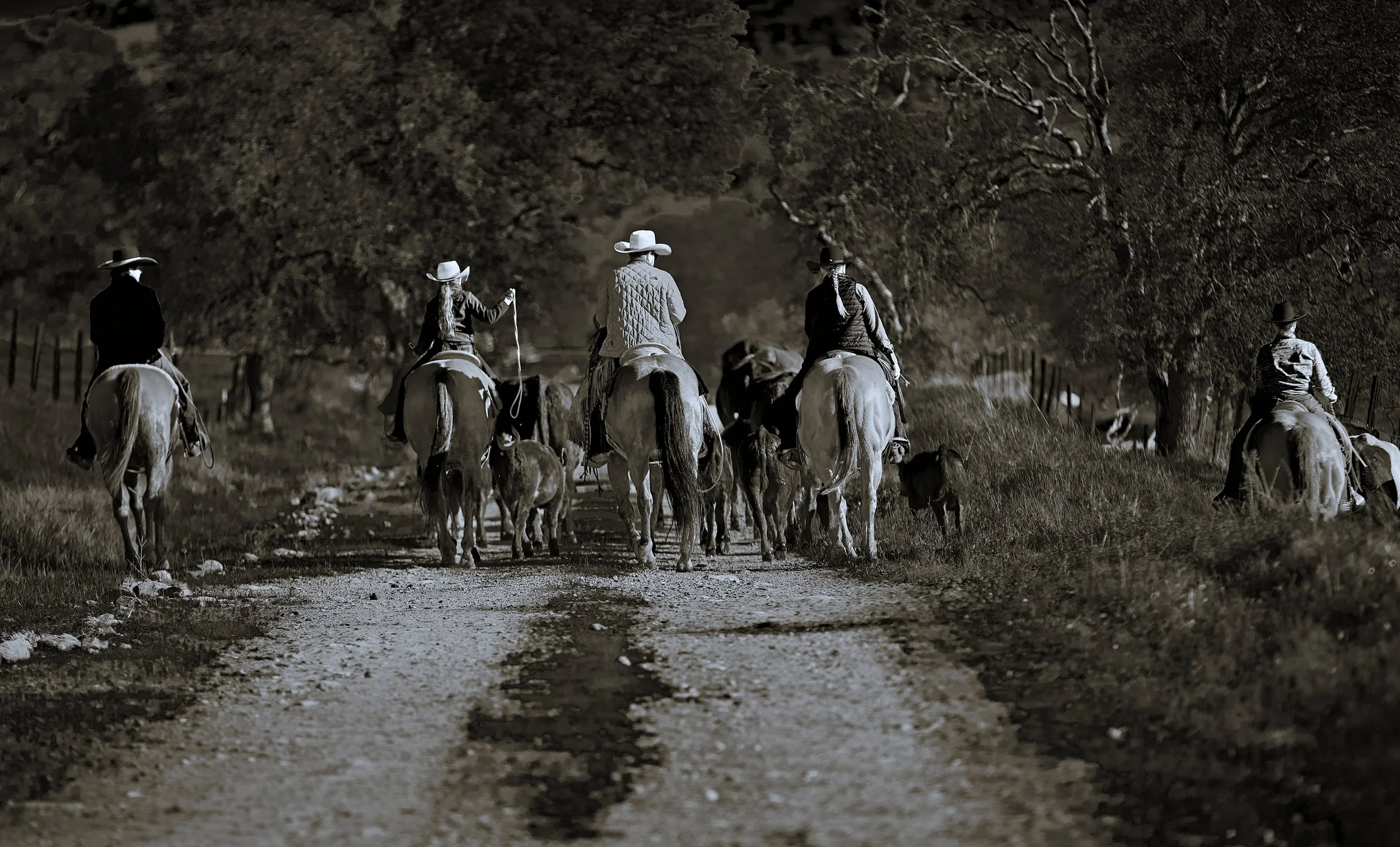
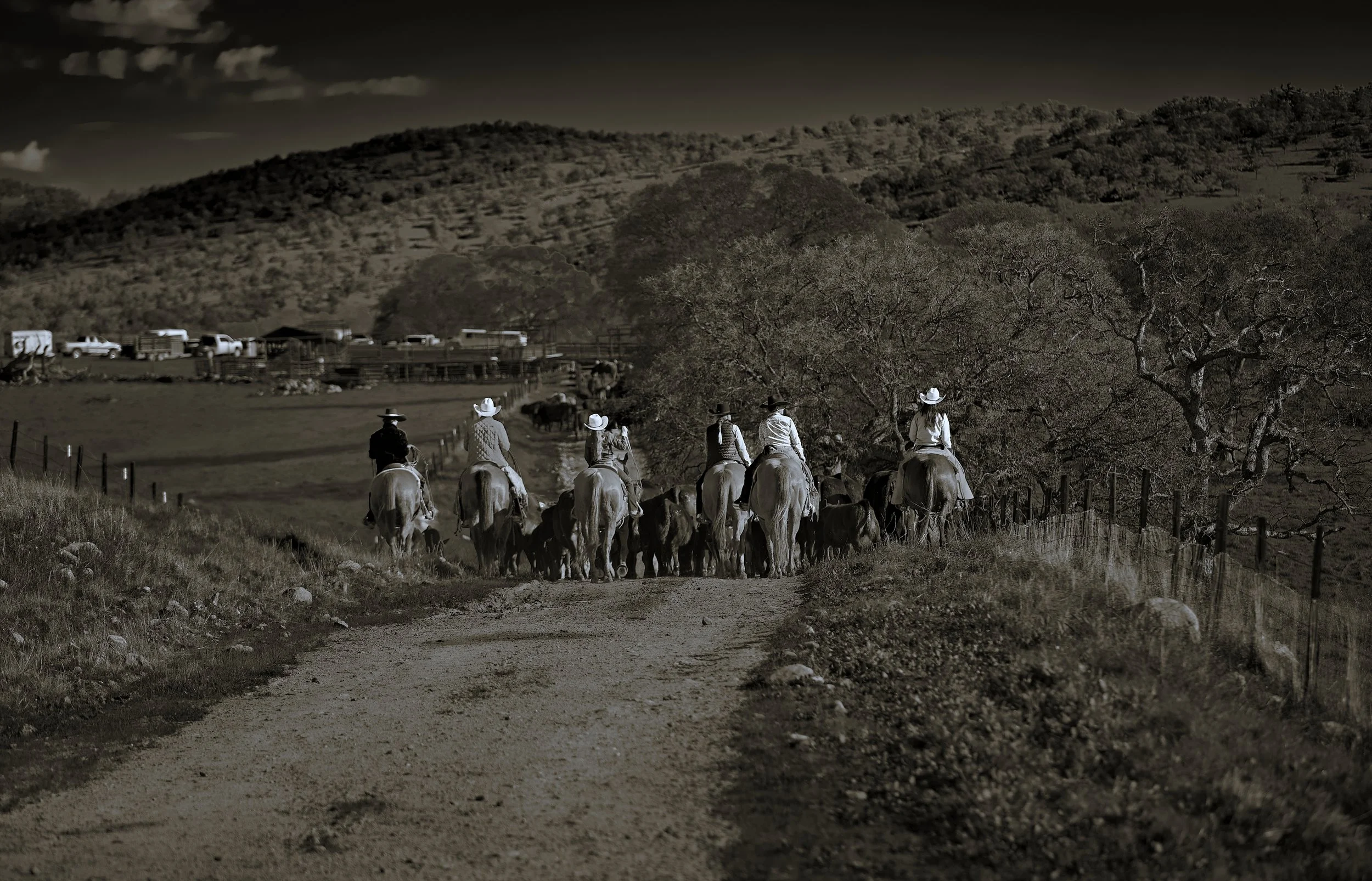
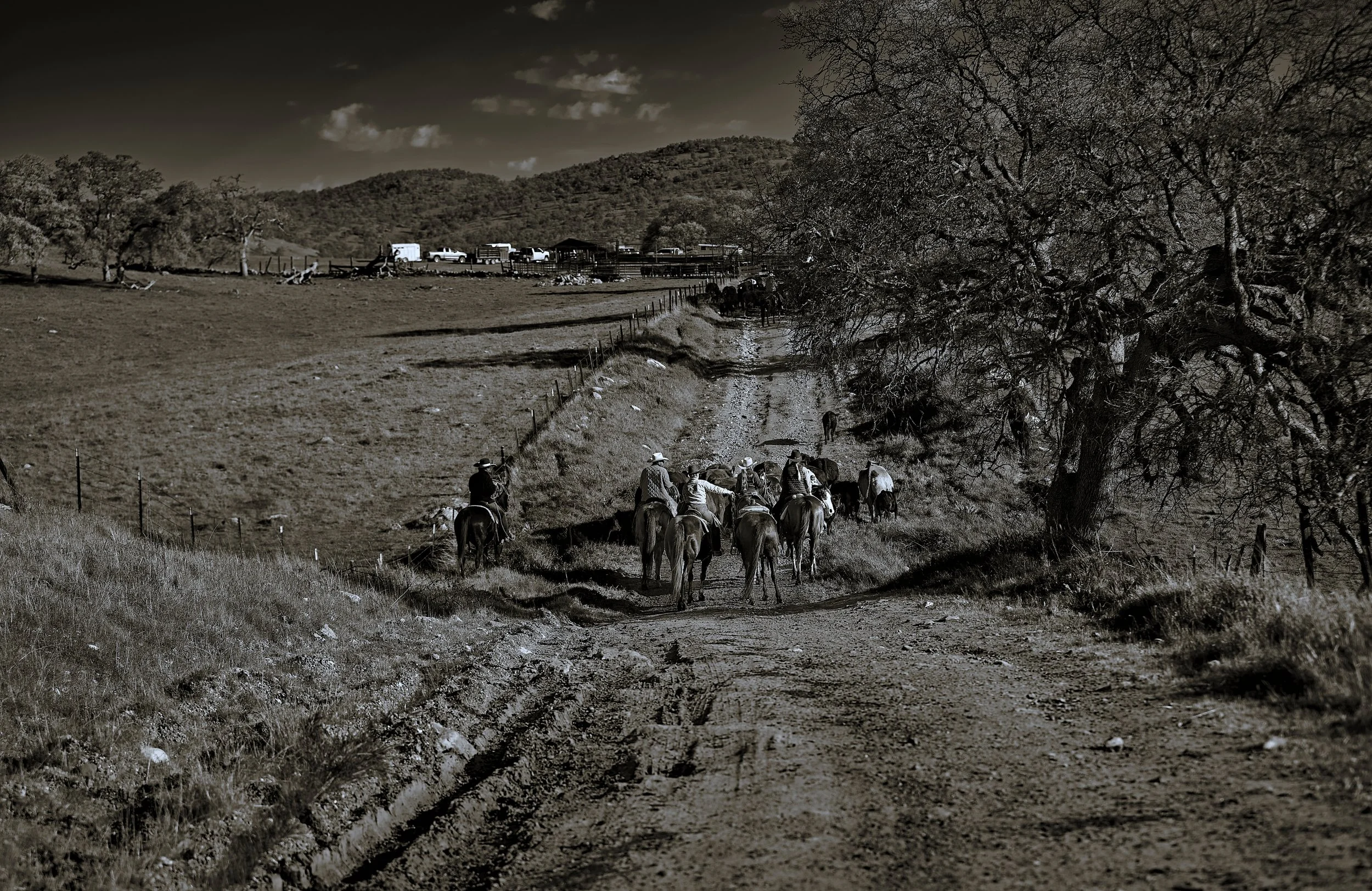
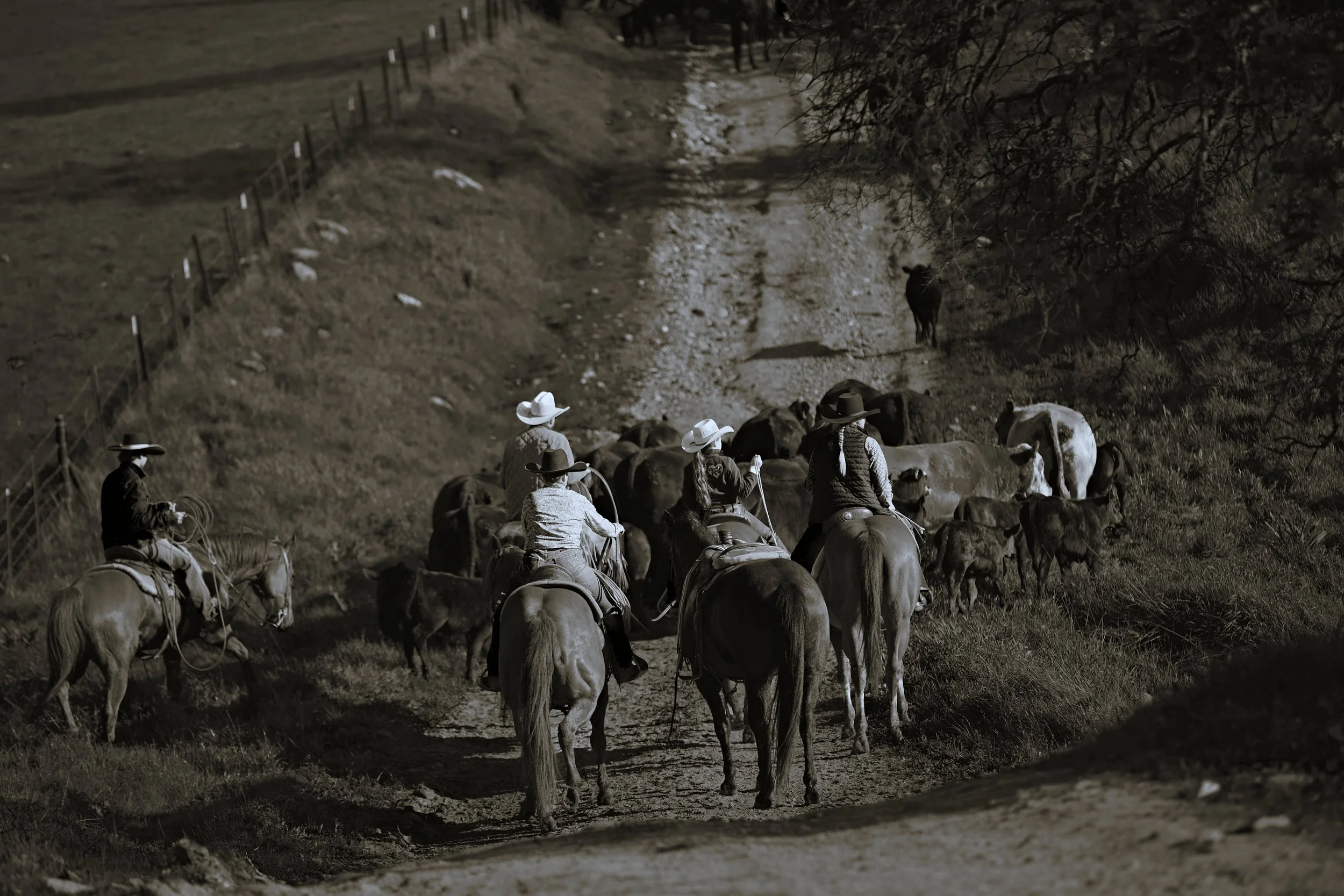
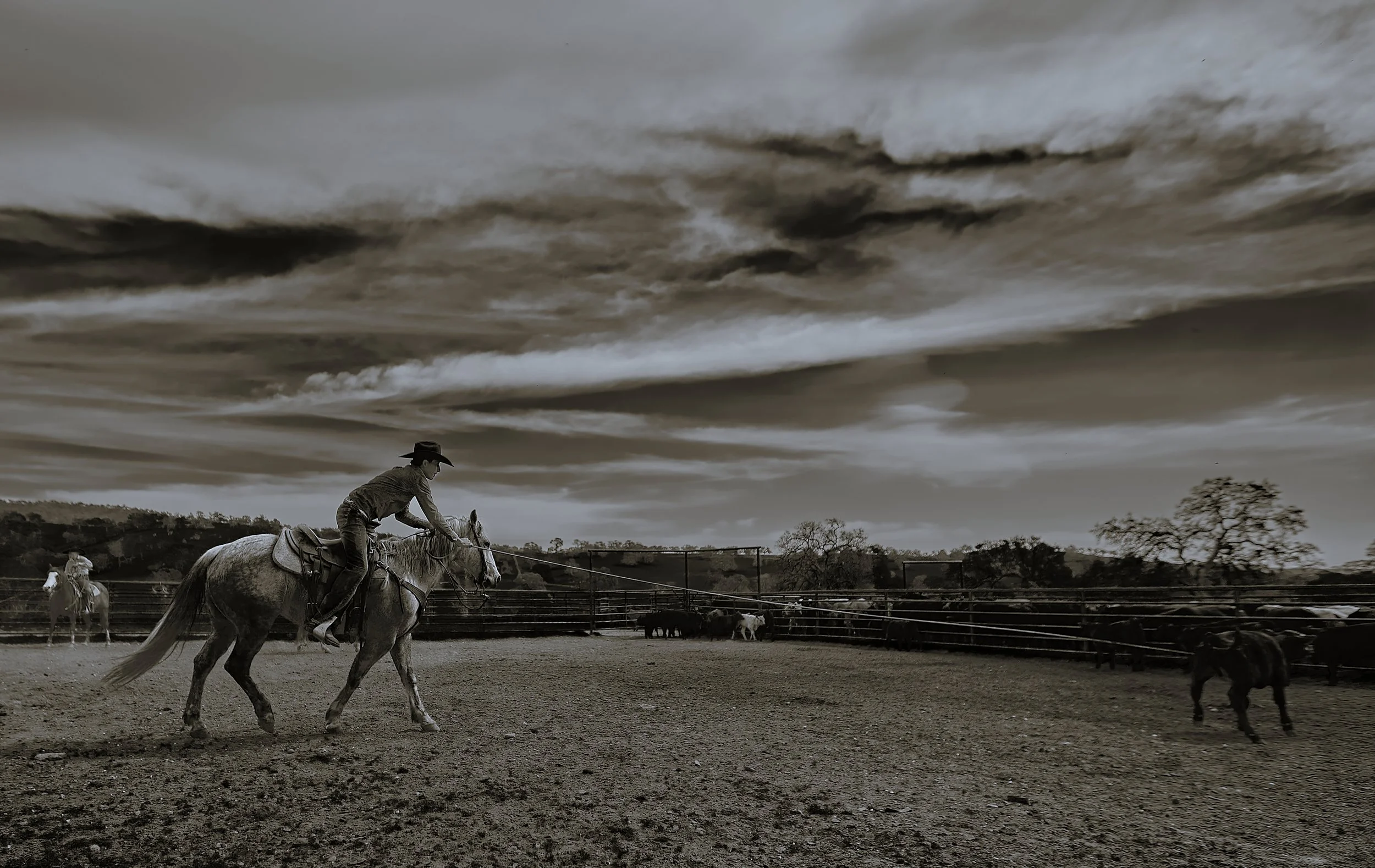
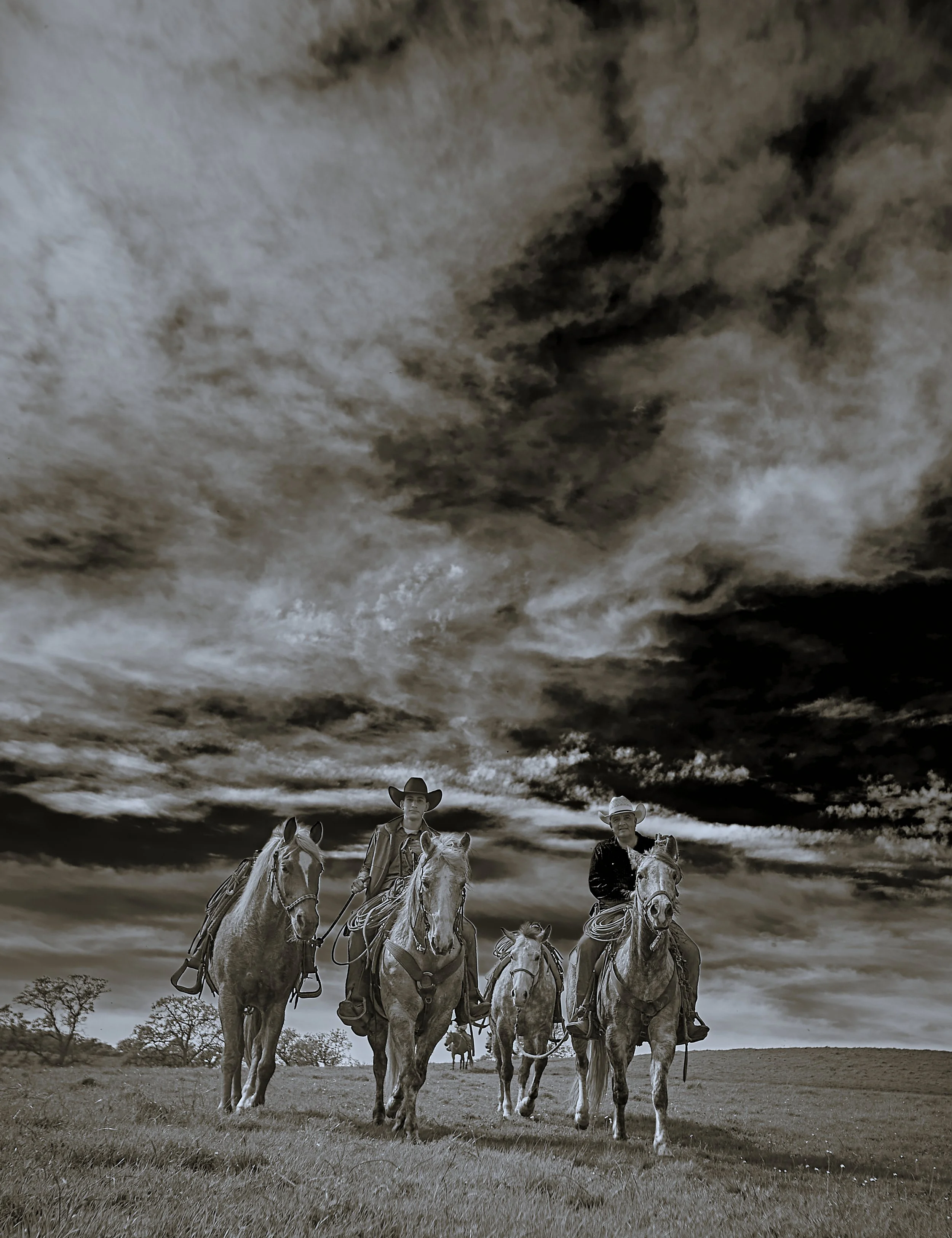
Through the open gate he goes. Alyn drives east along a partially dirt, gravel, and mud road, not knowing exactly where he will meet the cowboys and cowgirls riding “drag” or where the corrals are located for the day’s activities. Riding drag means riding behind the herd and pushing the cattle along, making sure neither calves nor cows escape.
KNIGHT’S FERRY
Before Alyn proceeds with his adventure, let him briefly divert to tell you a bit about Knight’s Ferry. The town, known for its historic covered bridge, was settled by William Knight during the winter of 1849–1850. Knight, a native of Indiana, settled on the north side of the Stanislaus River, ten miles upstream from Oakdale. He chose the site because it sat along the Sonora Road, which led from Stockton to the southern gold fields of Sonora and Mariposa during the height of the California Gold Rush.
His intent was to profit from the miners passing through by establishing a trading post and ferry crossing. Knight, however, never lived to see his fortune come to fruition. He was shot and killed by an unknown assassin on November 9, 1849. It is said that Knight was buried at the site where he fell, in the street near the southeastern corner where the Masonic Hall now stands. According to James G. Fair, later one of the Big Four owners of the Comstock Lode near Virginia City, Nevada, who was in town that day, it was one of the most “cold-blooded murders” he had ever witnessed.
After Knight’s murder, two brothers, Lewis and John Dent, took possession of what remained of the Knight estate. Lewis Dent arrived in California in 1847. He was in his early twenties and initially settled in Monterey, where he established a law office. A native of Missouri, Lewis was the first of his family to settle in California before the discovery of gold at Sutter’s Mill in 1848, at the site of present-day Sacramento.
After Lewis served as a delegate to California’s first Constitutional Convention in Monterey, he ran for the U.S. House of Representatives in the election held on November 13, 1849, but came up short. Soon after his unsuccessful political campaign, Lewis moved from Monterey to Knight’s Ferry to take over the William Knight estate in partnership with his brother John.
There is little in the historical record about John, but we do know that during his time in Knight’s Ferry, he acted as an Indian agent for the local Lakisamni Yokut Tribe and was one of the signers of a treaty dated May 28, 1851.
It should be noted that Lewis and John were brothers-in-law to Ulysses S. Grant, the future general of the Union armies during the American Civil War and, later, the two-term President of the United States. Grant was married to Lewis and John’s sister, Julia, whom he wed on August 22, 1848.
In 1852, Ulysses graduated from West Point with the rank of second lieutenant in the United States Army. Soon afterward, he found himself in Mexico serving in the Mexican-American War. After his service in Mexico, he was stationed in Benicia, California, and Vancouver, Washington, before being promoted to captain and quartermaster at Fort Humboldt in Northern California, where he served for five months.
While traveling to and from San Francisco and these stations in the Northwest, and before resigning from the army and briefly taking up farming on his father-in-law’s estate near St. Louis, Missouri, Grant visited his brothers-in-law in Knight’s Ferry on at least two occasions, in 1852 and 1854. He was so impressed with Louis and John Dent’s successful undertakings in Knight’s Ferry that he contemplated moving Julia and their young family to California. Neither that plan nor long-term farming came to pass, however, as the army came calling once again, along with the fame that would follow.
BACK ON TRACK
Now, back to the day’s task at hand. If you remember, Alyn is heading east along a muddy dirt-and-gravel path, continuing to search for the cowboys and cowgirls riding drag on the Doornenbal Cattle ranch at Church Spring, a few miles north-northeast of present-day Knight’s Ferry.
Because of ruts and washouts, his top speed is six miles per hour. Finally, after driving at that speed or less and cresting and descending one rolling hill after another for what feels like an eternity, he spots, in the far distance—at least a hill or two ahead—the cowboys and cowgirls pushing cattle. The corrals where the branding will take place are not yet visible, but they soon come into view as he continues down the road.
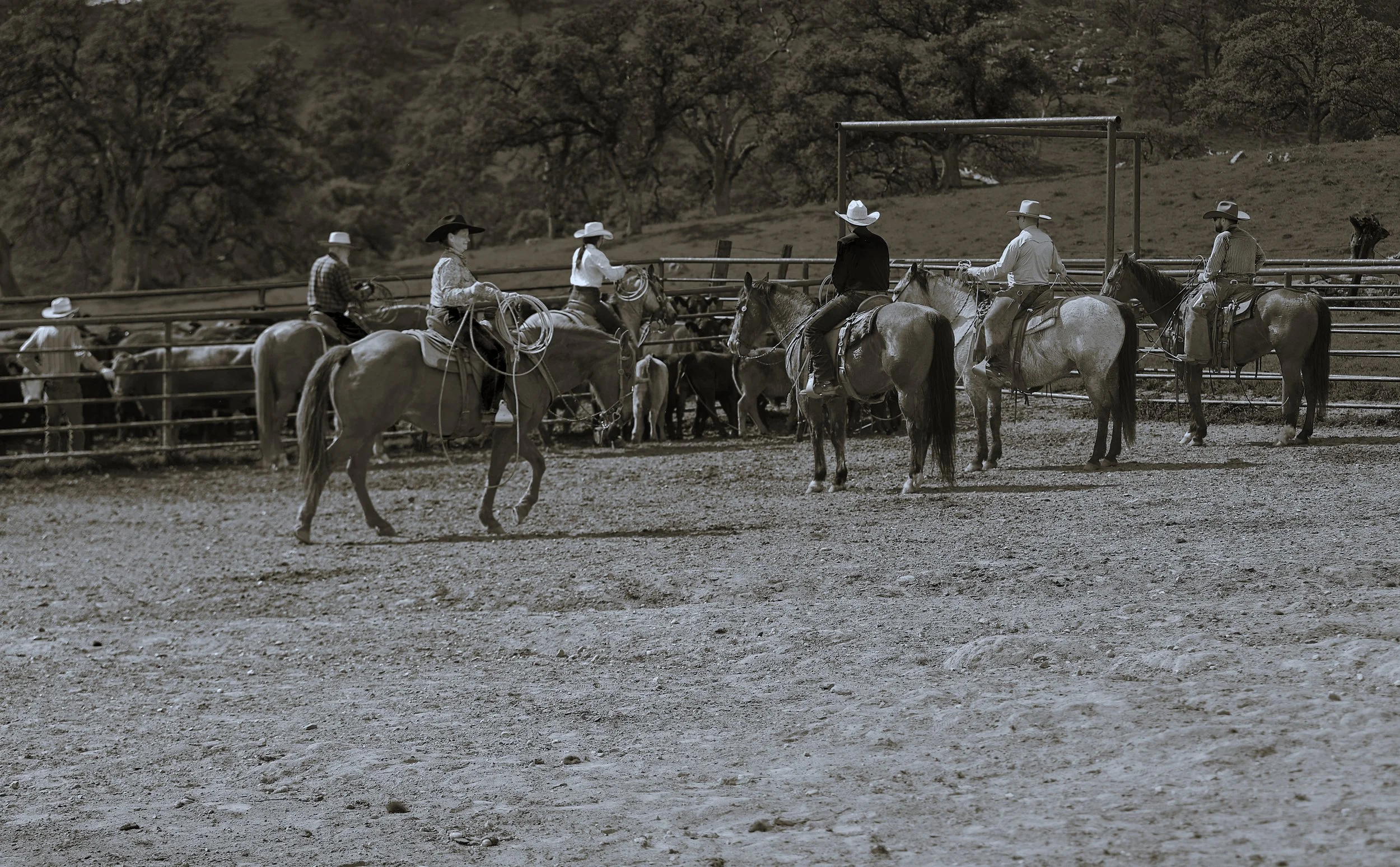
Ten or so minutes later, after catching up with the crew and cattle and photographing their progress, Alyn arrives at the corrals. Shortly afterward, the cattle are herded into a fairly large fenced enclosure divided in half by additional fencing.
The western half of the corral is where all the cows with calves are initially gathered. The eastern half is where the branding takes place. Soon, the crew begins separating the calves and herding them from the western corral into the eastern one, closer to the tools required for the main event of the day: branding.
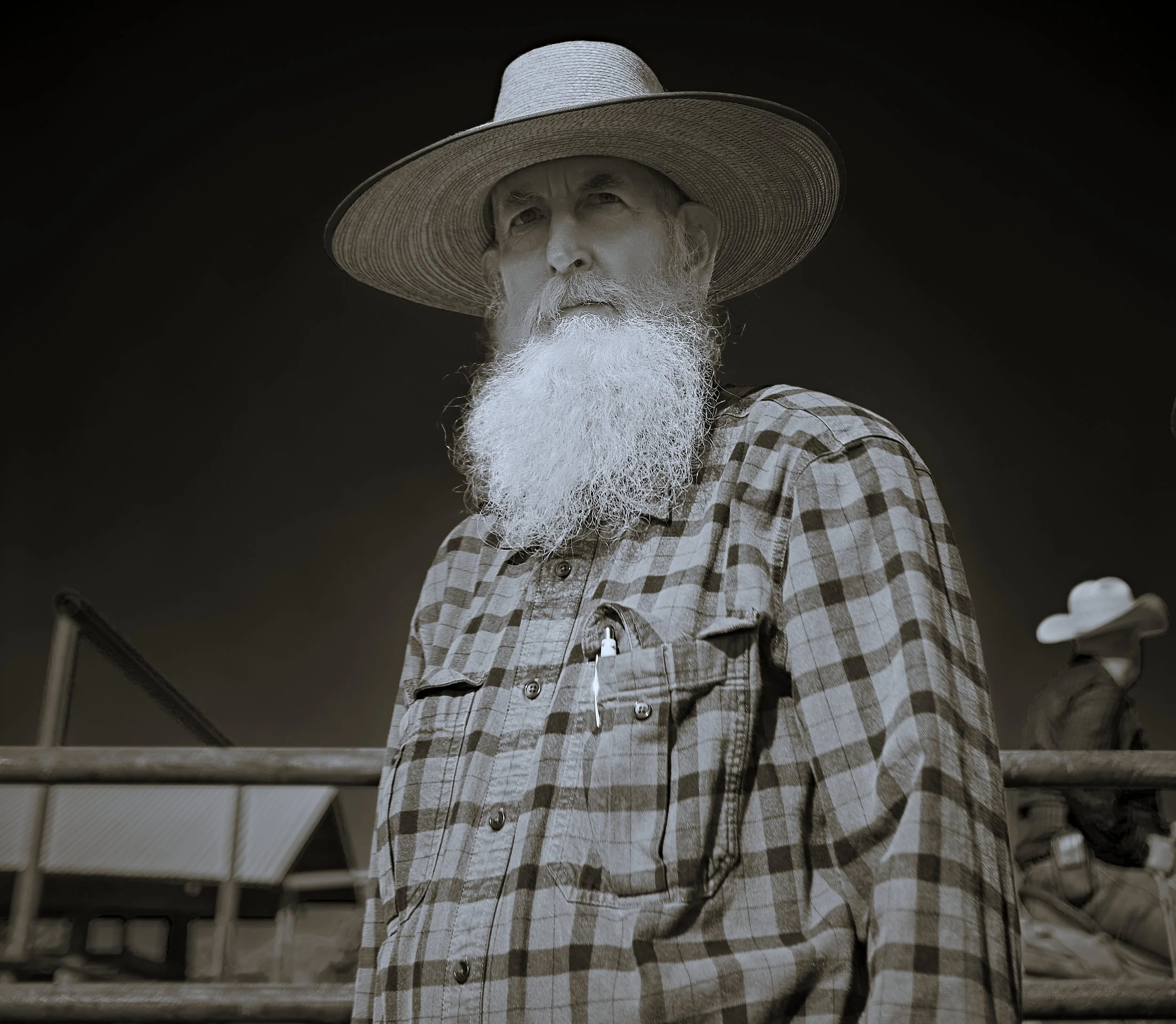
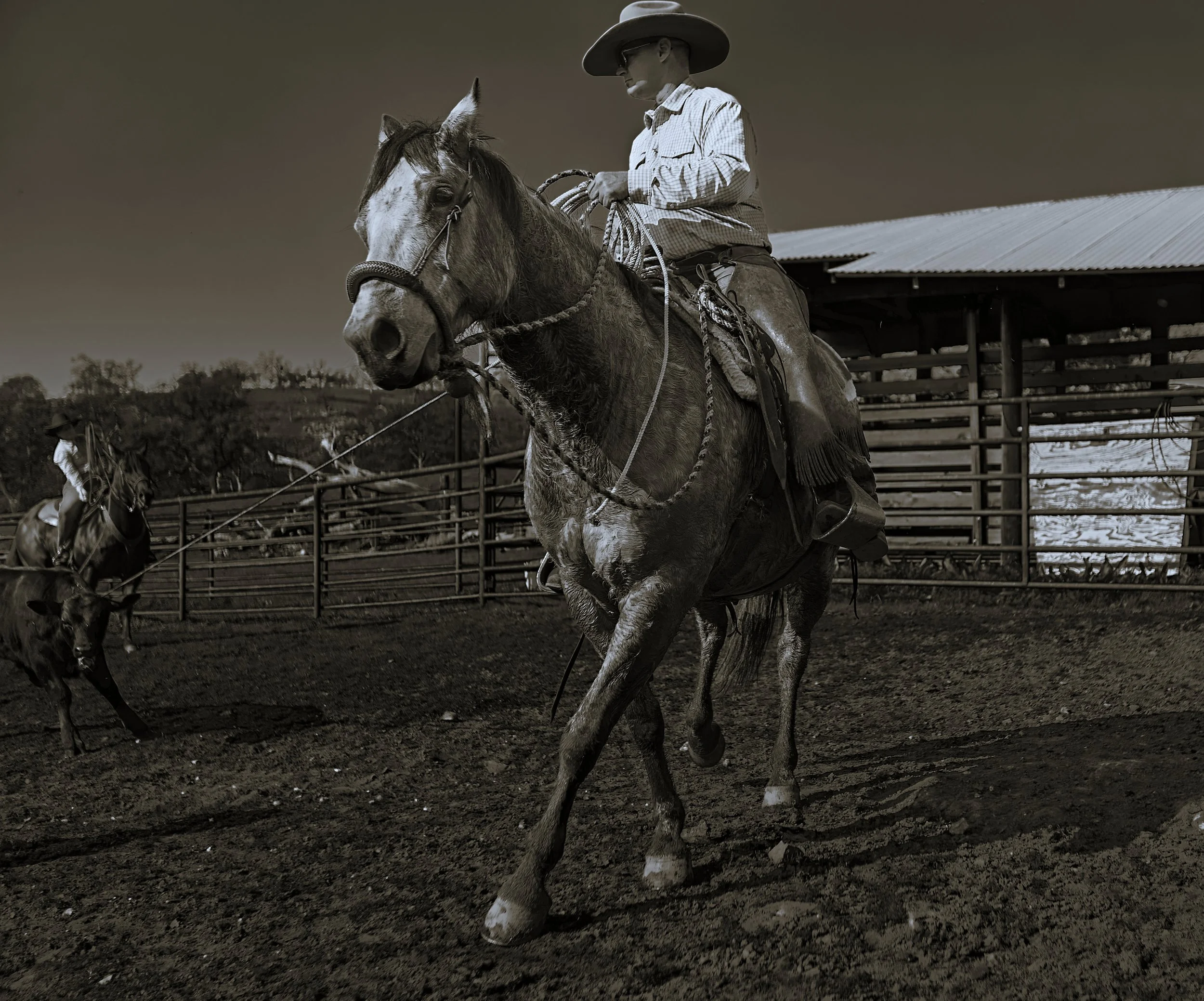
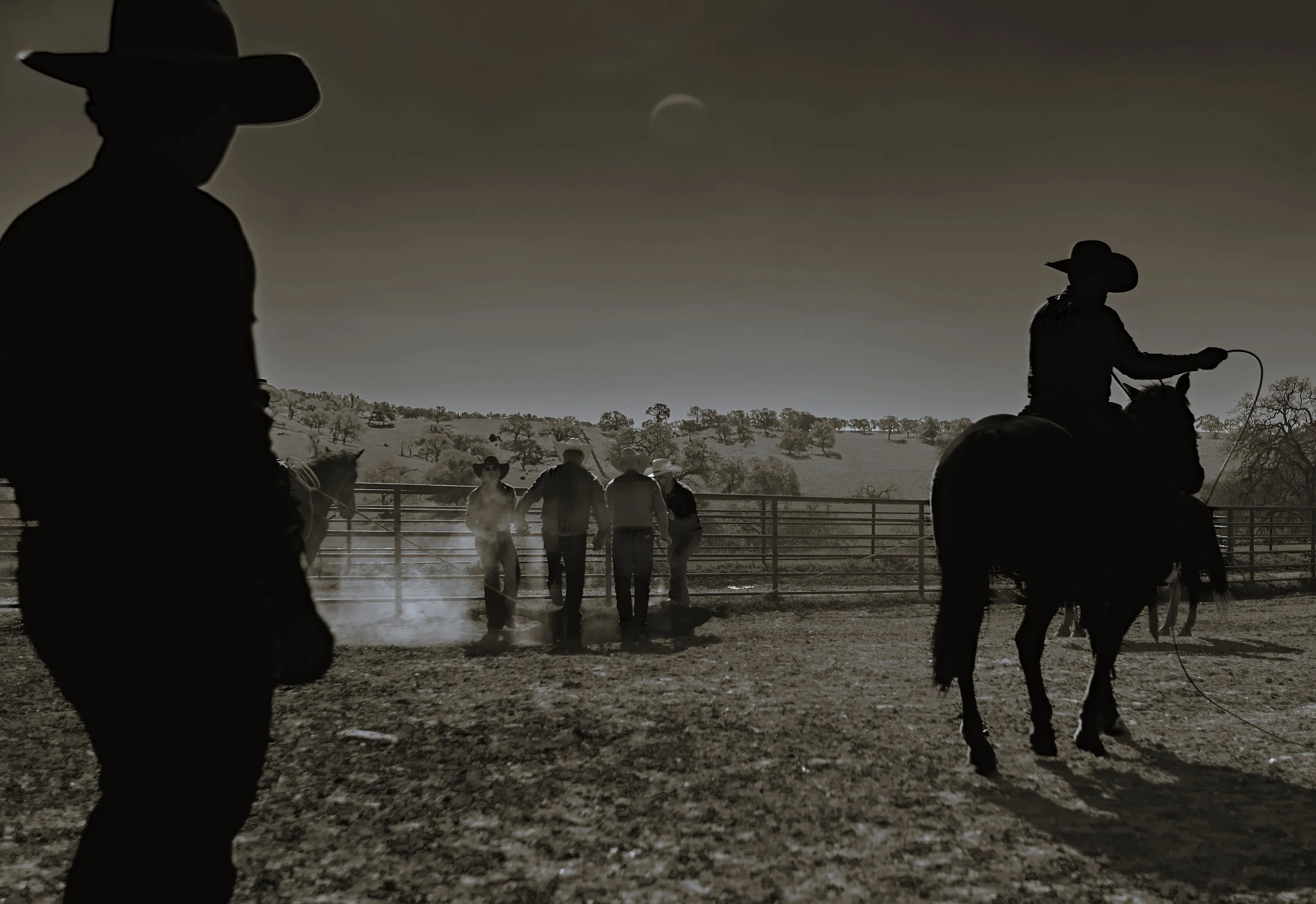
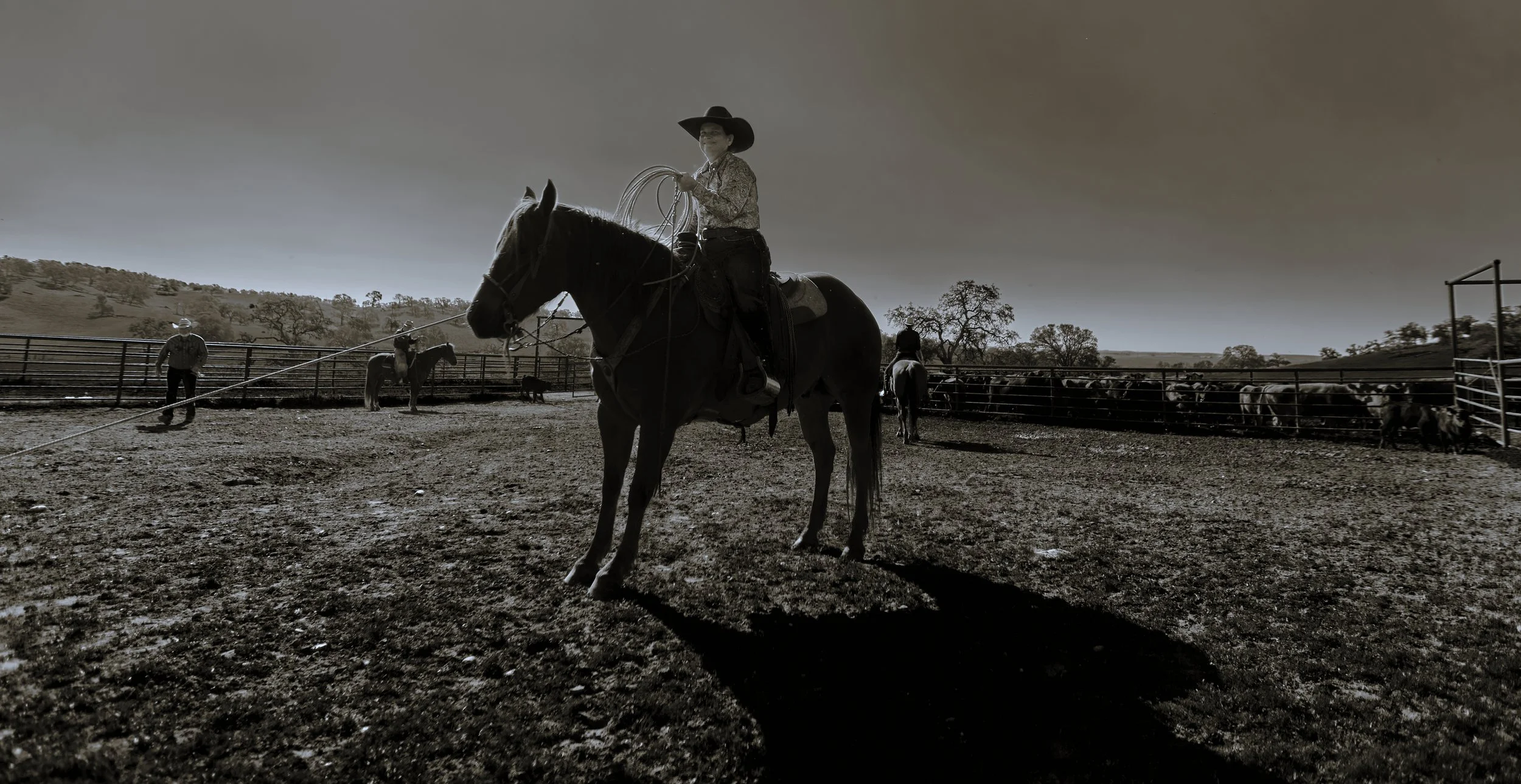
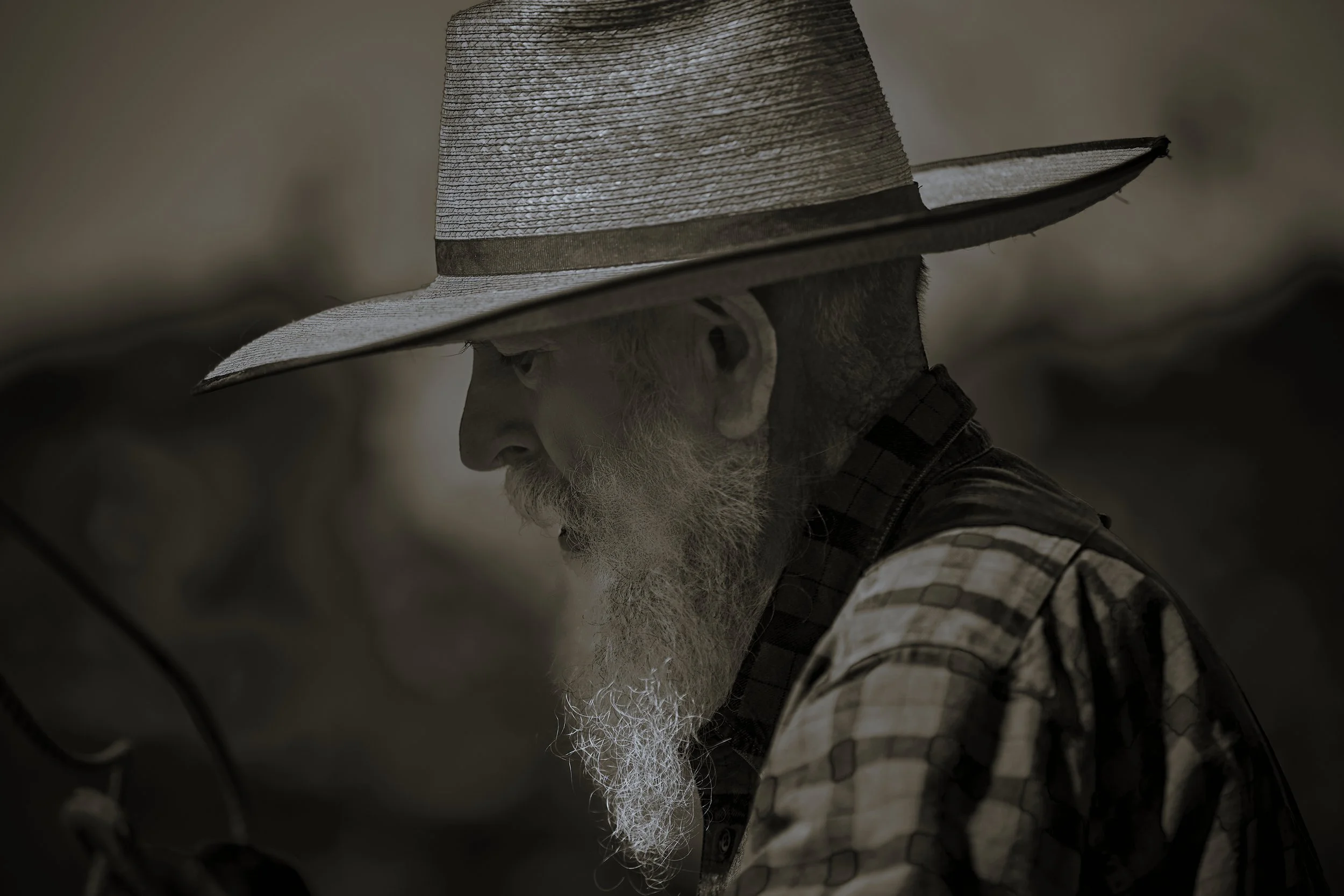
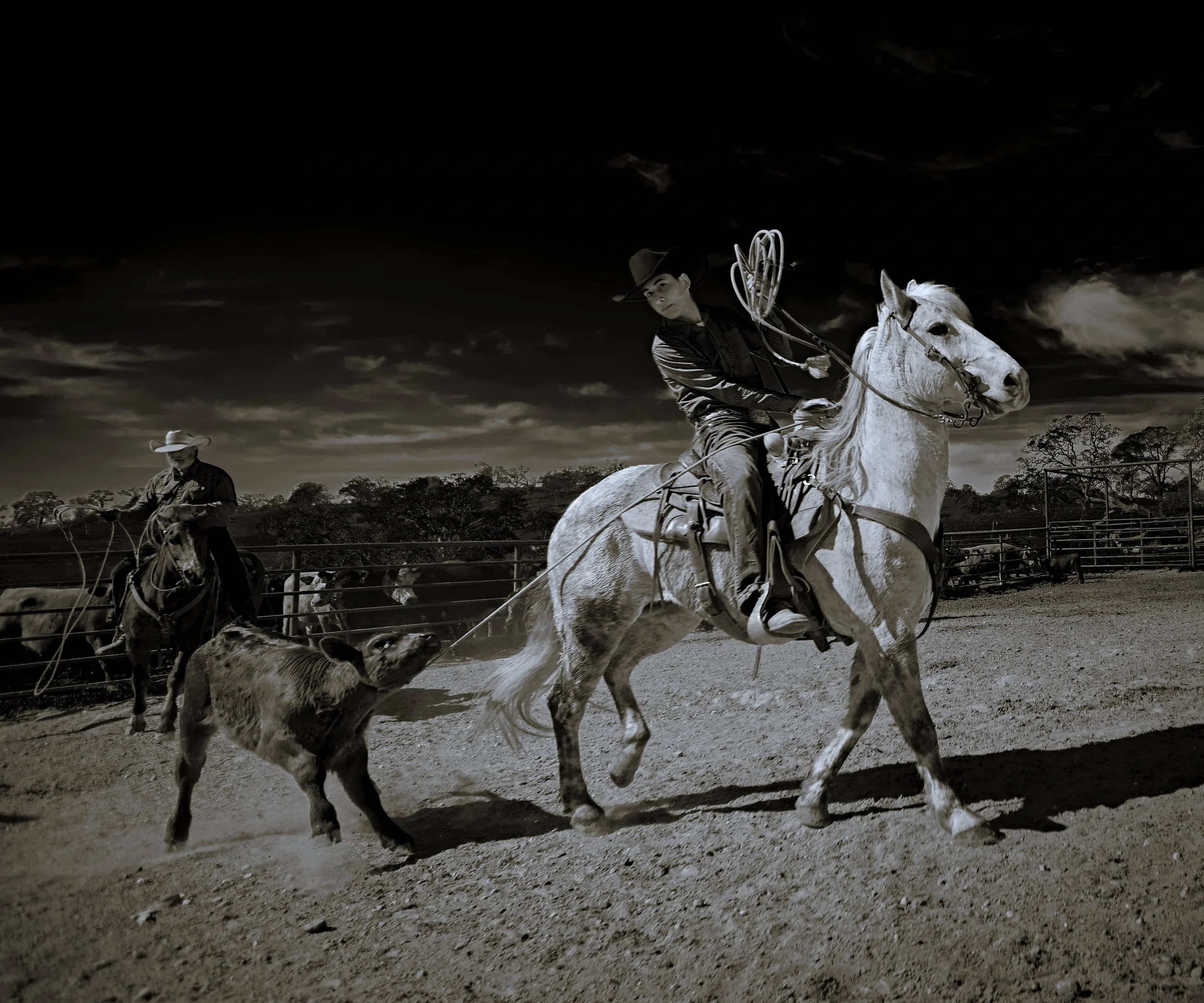
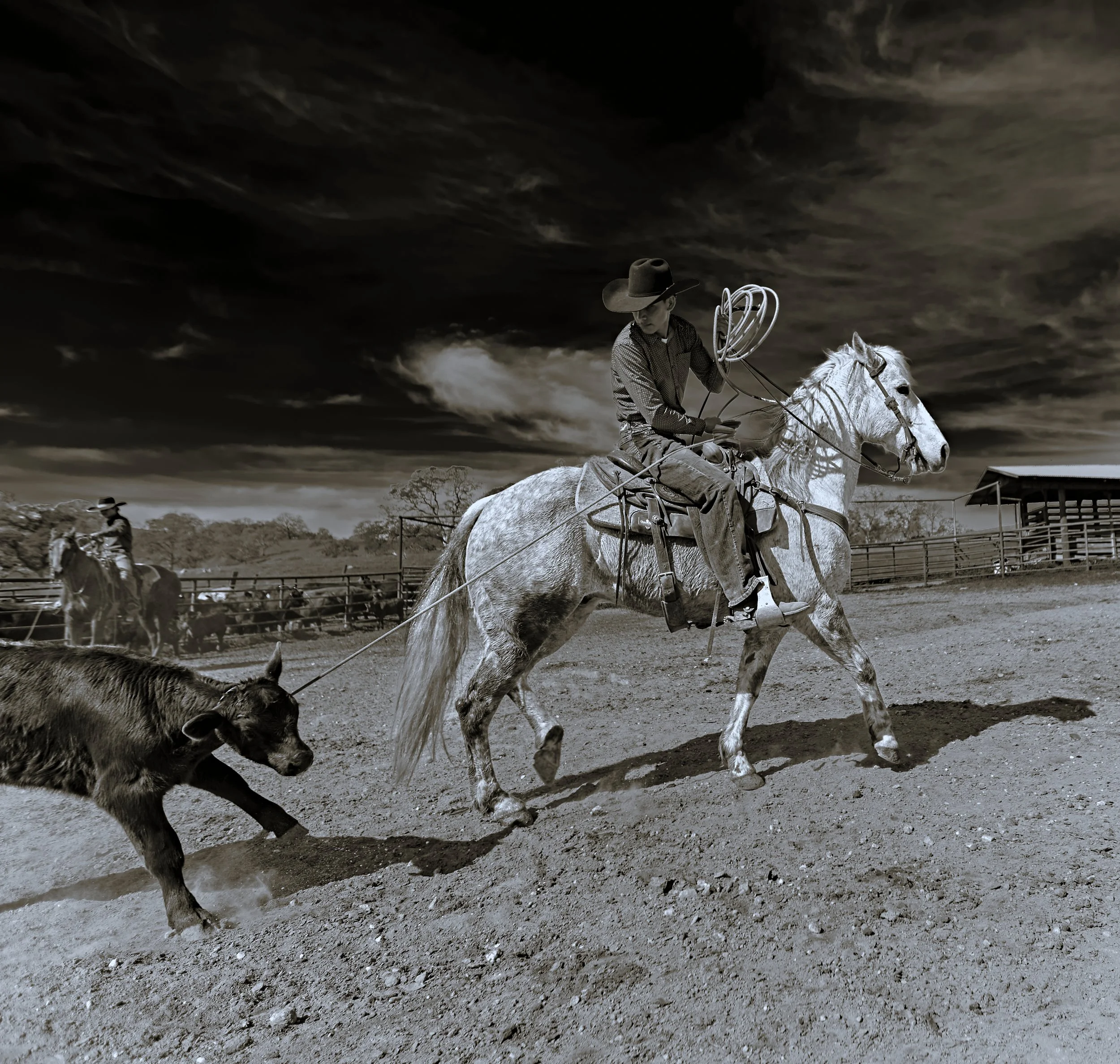
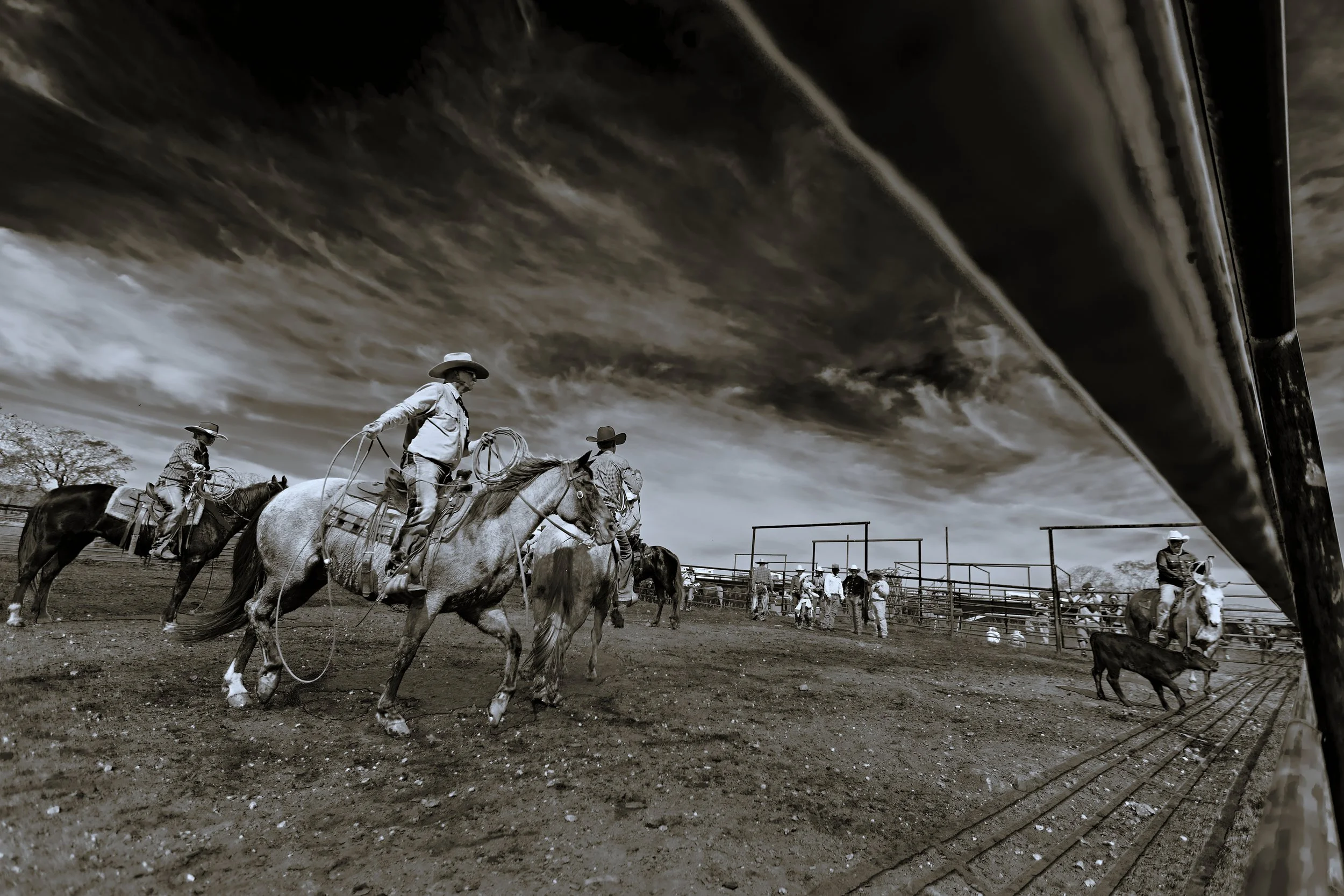
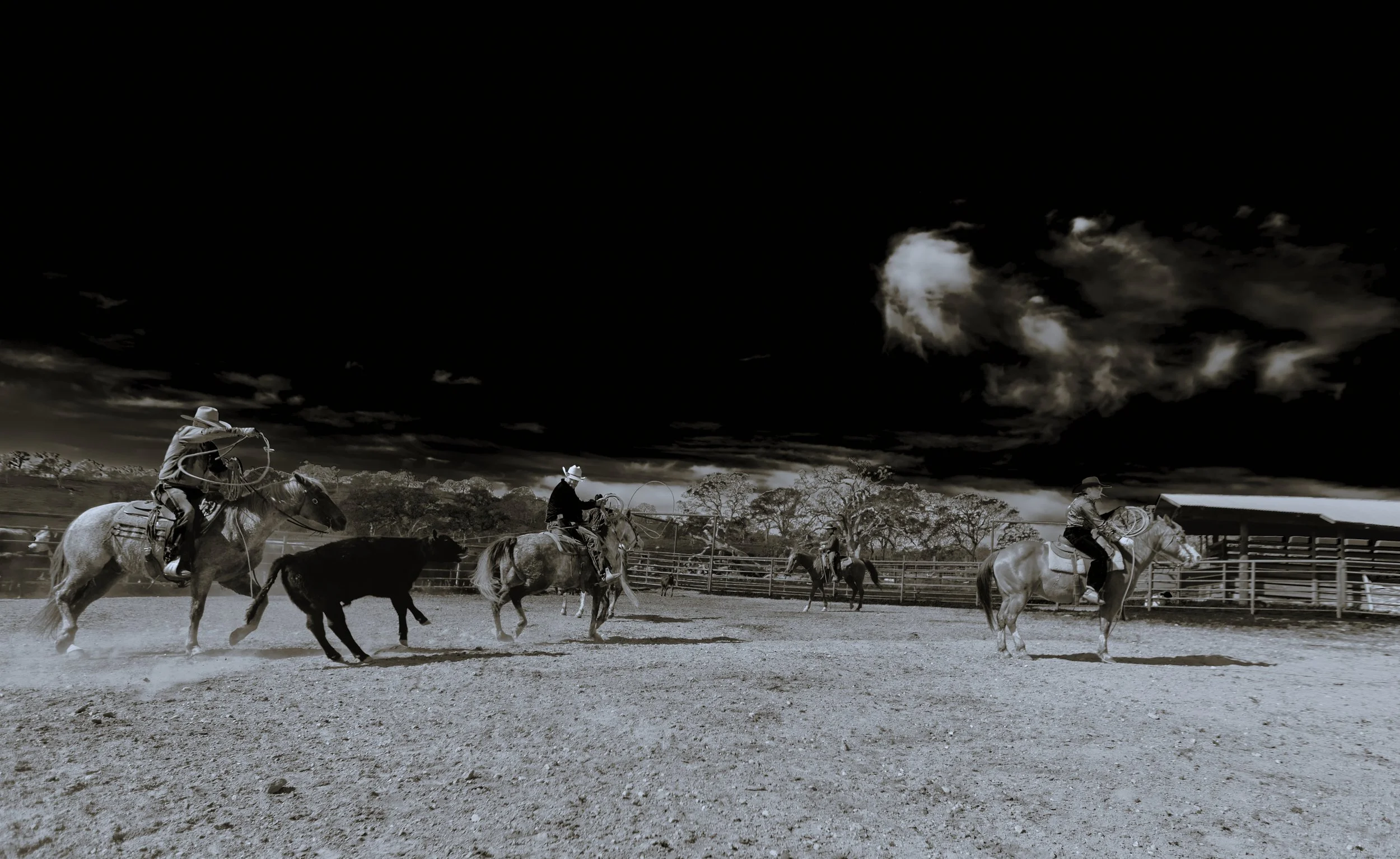
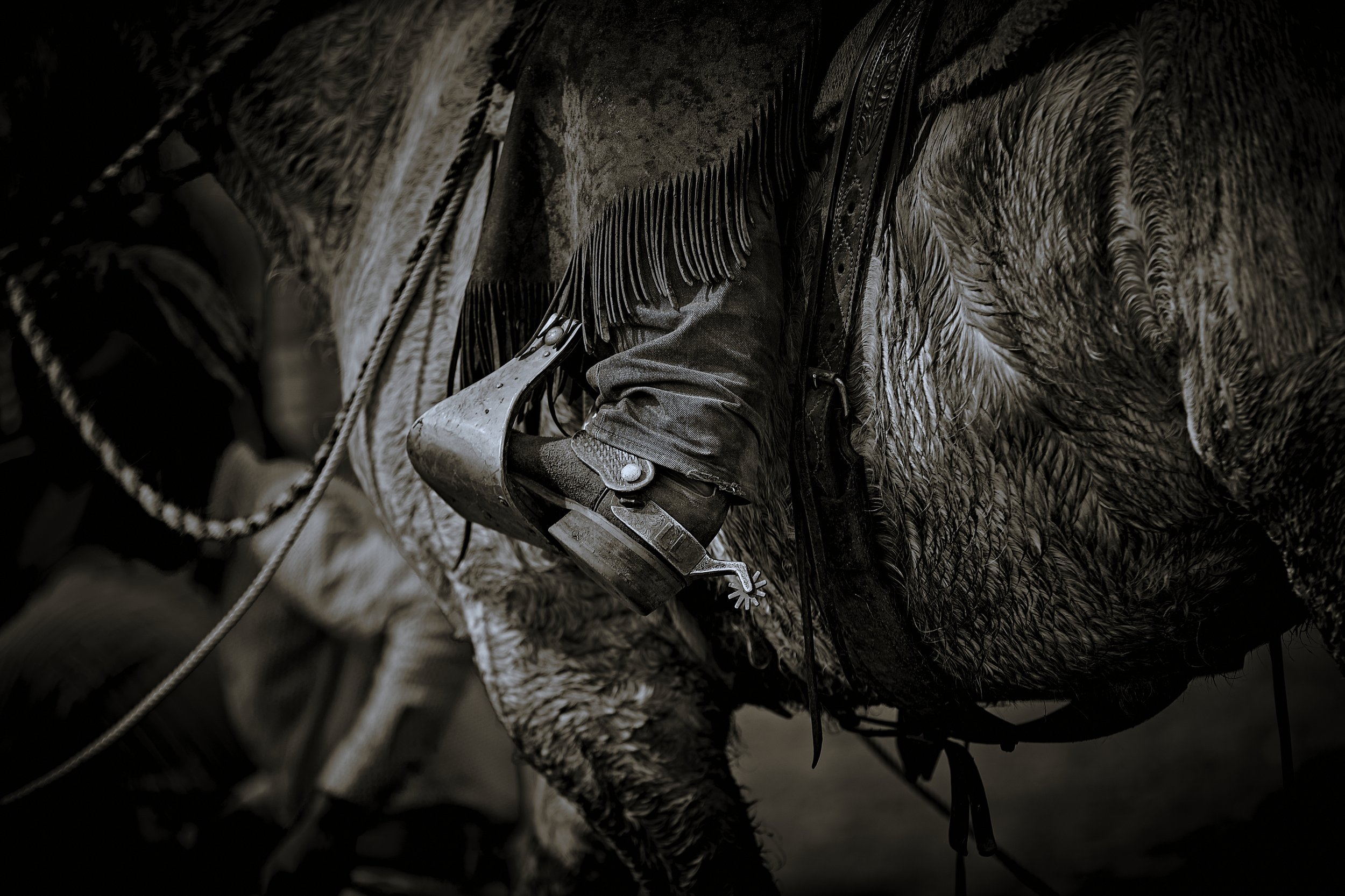
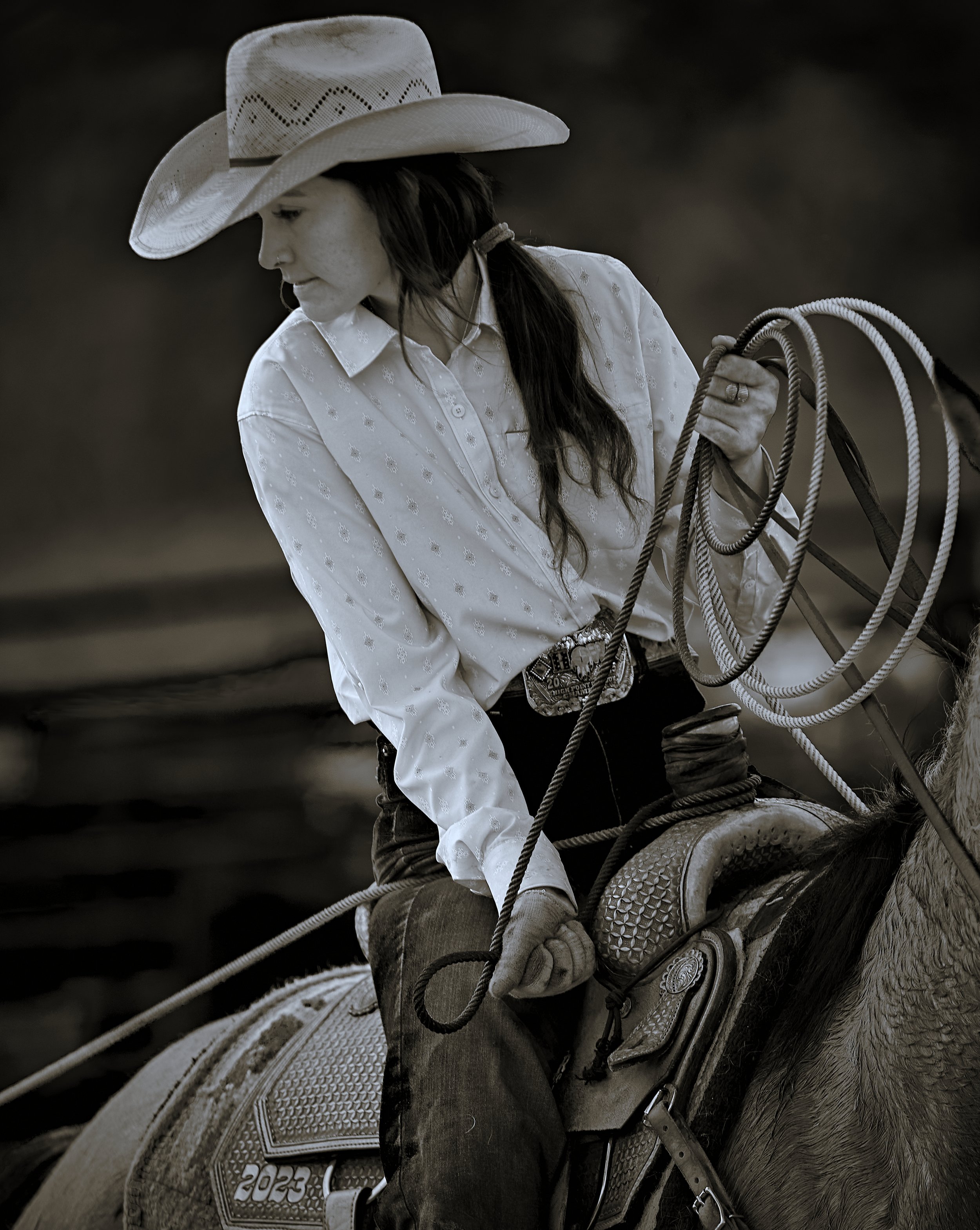
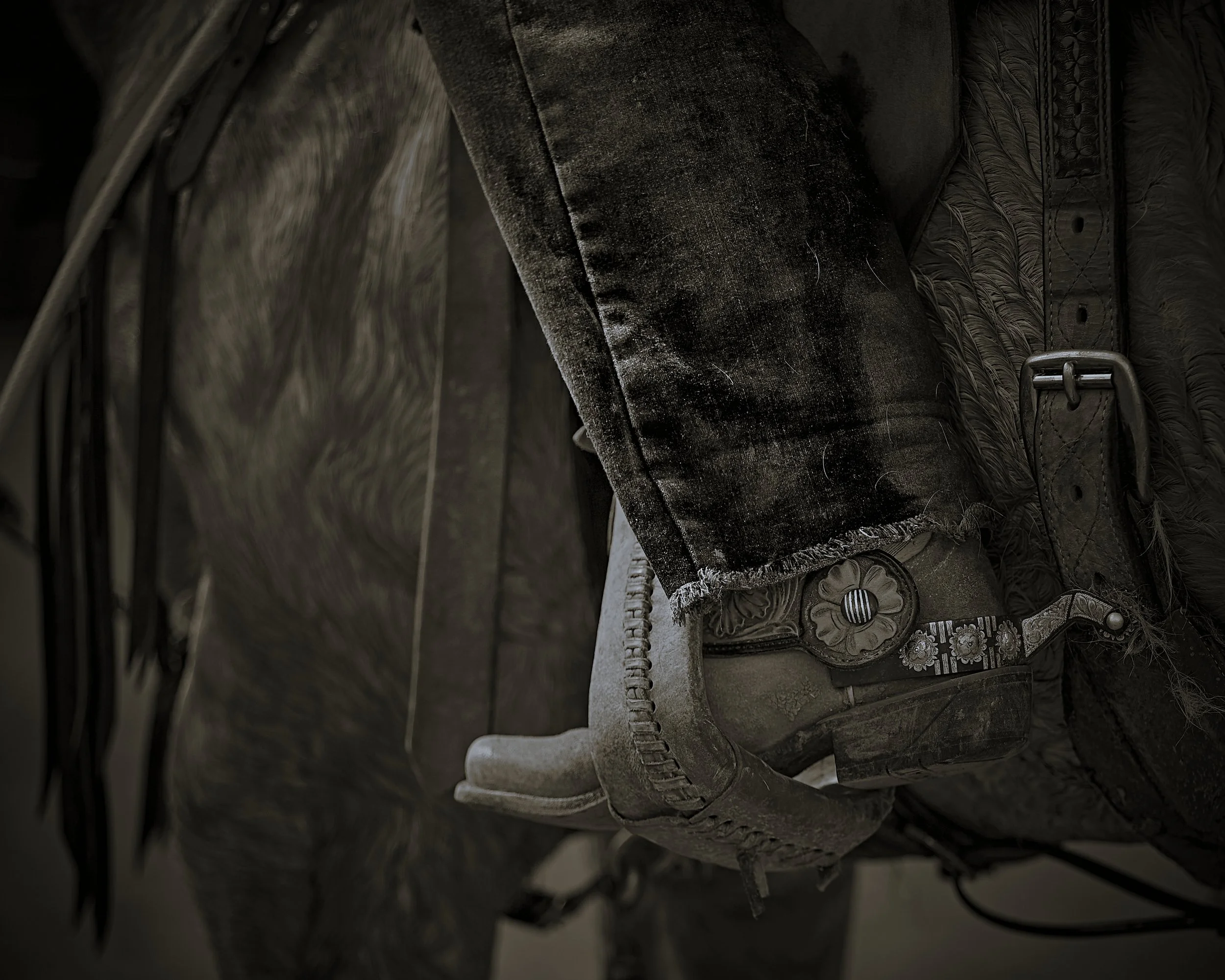
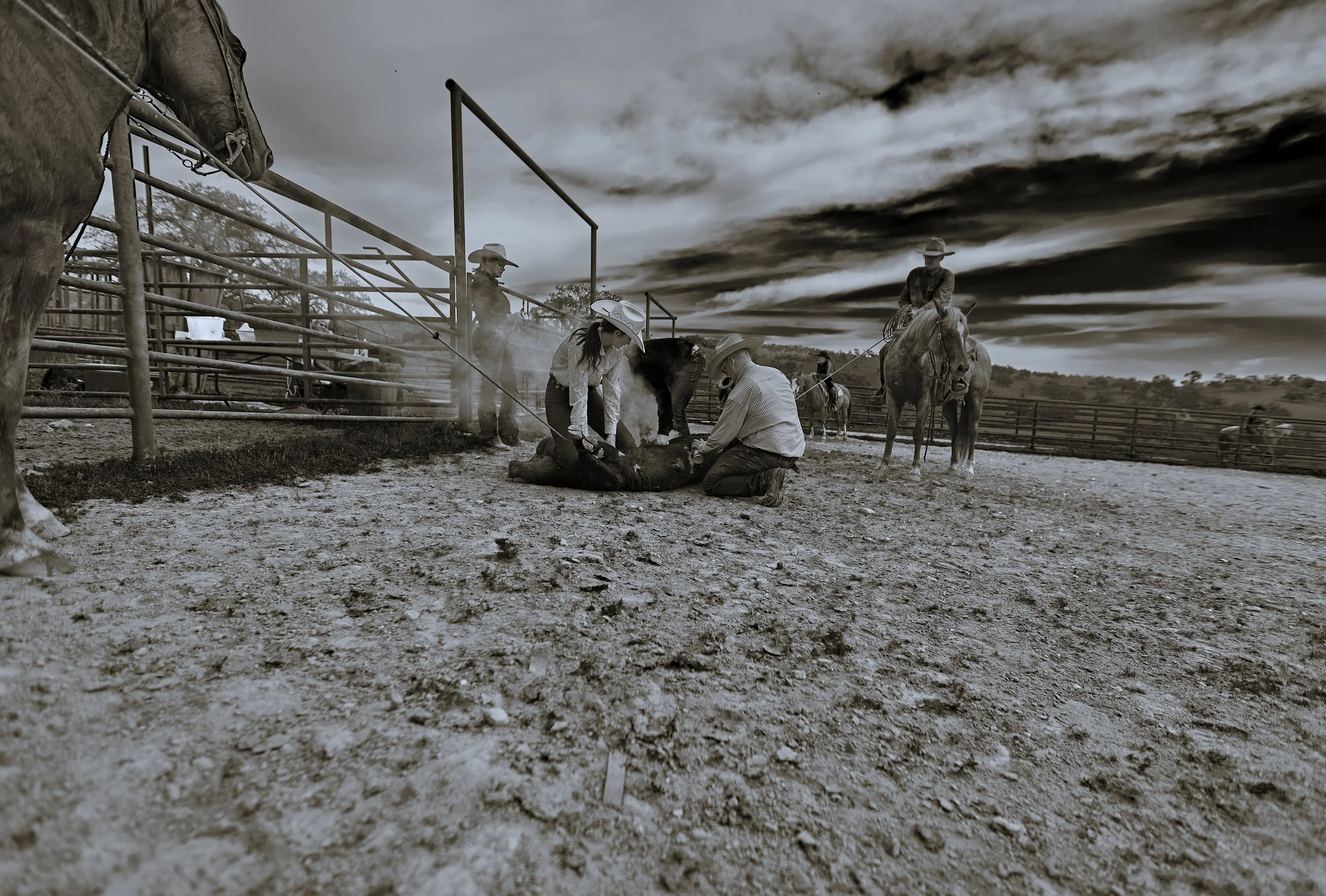
And as the branding begins, this is the point in the story where Alyn’s narration must end. But it is also where his photographs begin. Only photographs can provide a true “picture” of the task at hand—the highly skilled and physically demanding work that the cowboy and cowgirl way of life demands.
So let the pictures begin. Enjoy the show. And thanks for “riding” along.
NOTE
The photographs Alyn shot at the roundup and branding that day were converted from color to sepia during post-production. The advantage of sepia over color is that it gives the images a look that complements the style and atmosphere viewers have come to associate with cowboy and cowgirl culture of long ago.
BIO
A primatologist by training, Alyn’s academic interest is in the behavior of monkeys and apes. For his doctorate, he studied stump-tailed macaques on Tanaxpillo Island in Laguna Catemaco, near the small town of Catemaco in the state of Veracruz, Mexico. He earned his Doctor of Philosophy (PhD) degree from the University of Stirling in Stirling, Scotland, where he lived for two years while writing his thesis in the late 1980s.
Alyn worked for many years as an archaeologist in California and Nevada and as an ethnoarchaeologist along the Bering Sea in Alaska before beginning a second career teaching International Baccalaureate anthropology and psychology at the high-school level.
Alyn is a fully credentialed Professional Rodeo Cowboys Association (PRCA) photographer with a passion for fine-art photography and the cowboy way of life. The latter is the environment in which he was raised. He resides in Modesto, California.
Alyn is the author of COWBOYS AND RODEOS, published by Gibbs Smith and released on August 15, 2023. The book is available wherever books are sold.
Alyn’s website: brerdog.com
Alyn’s source for the history of Knight’s Ferry: Brotherton, I. N., ANNALS OF STANISLAUS COUNTY (1982), Western Tanager Press, Santa Cruz, California.
Alyn thanks Scott Heiny and his crew for sharing a small portion of the world they live and breathe each day—the all-American Western Way. He offers Scott special thanks for providing the names of each team member.
Names of individual(s) pictured (from left to right)…
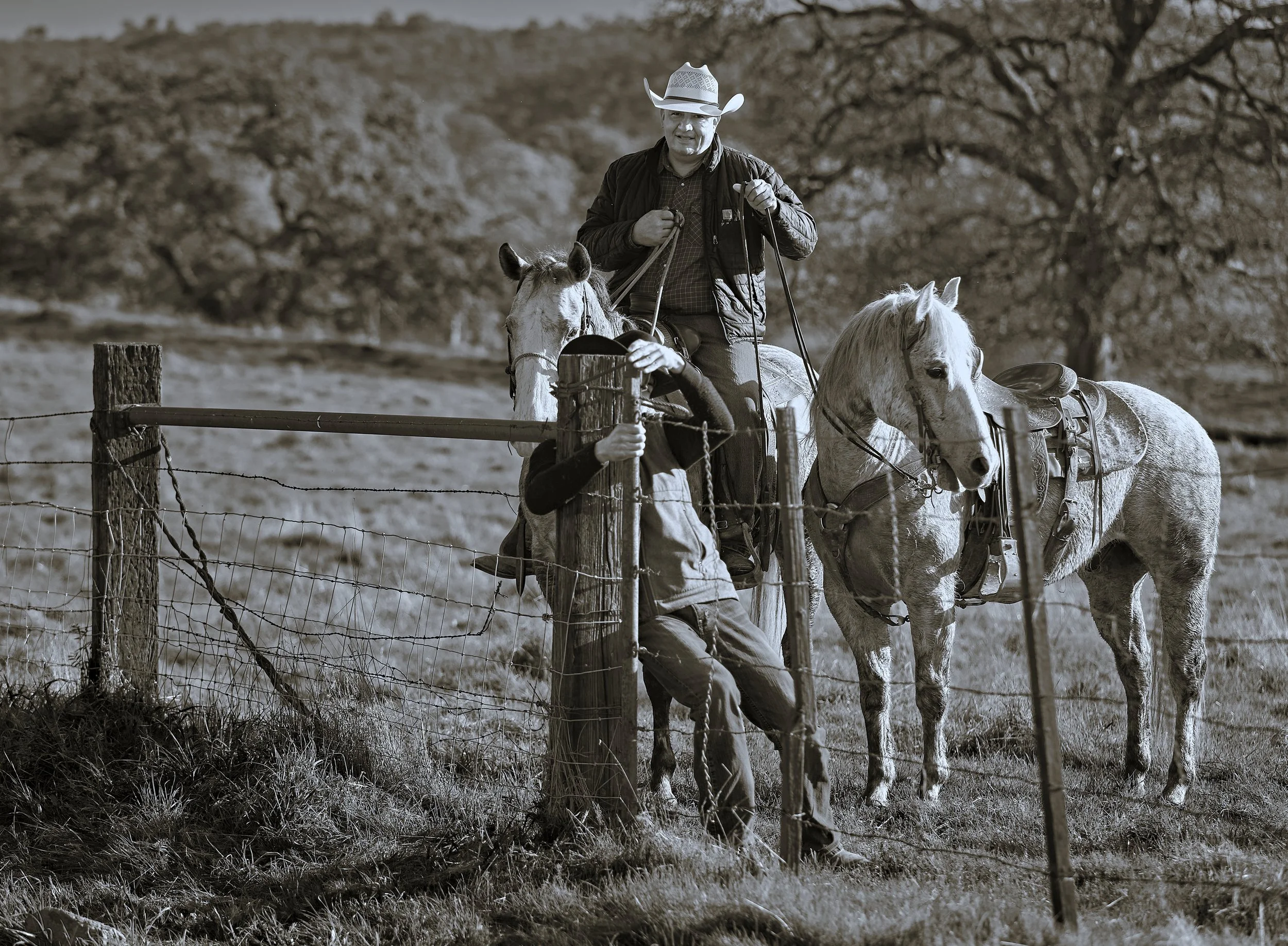
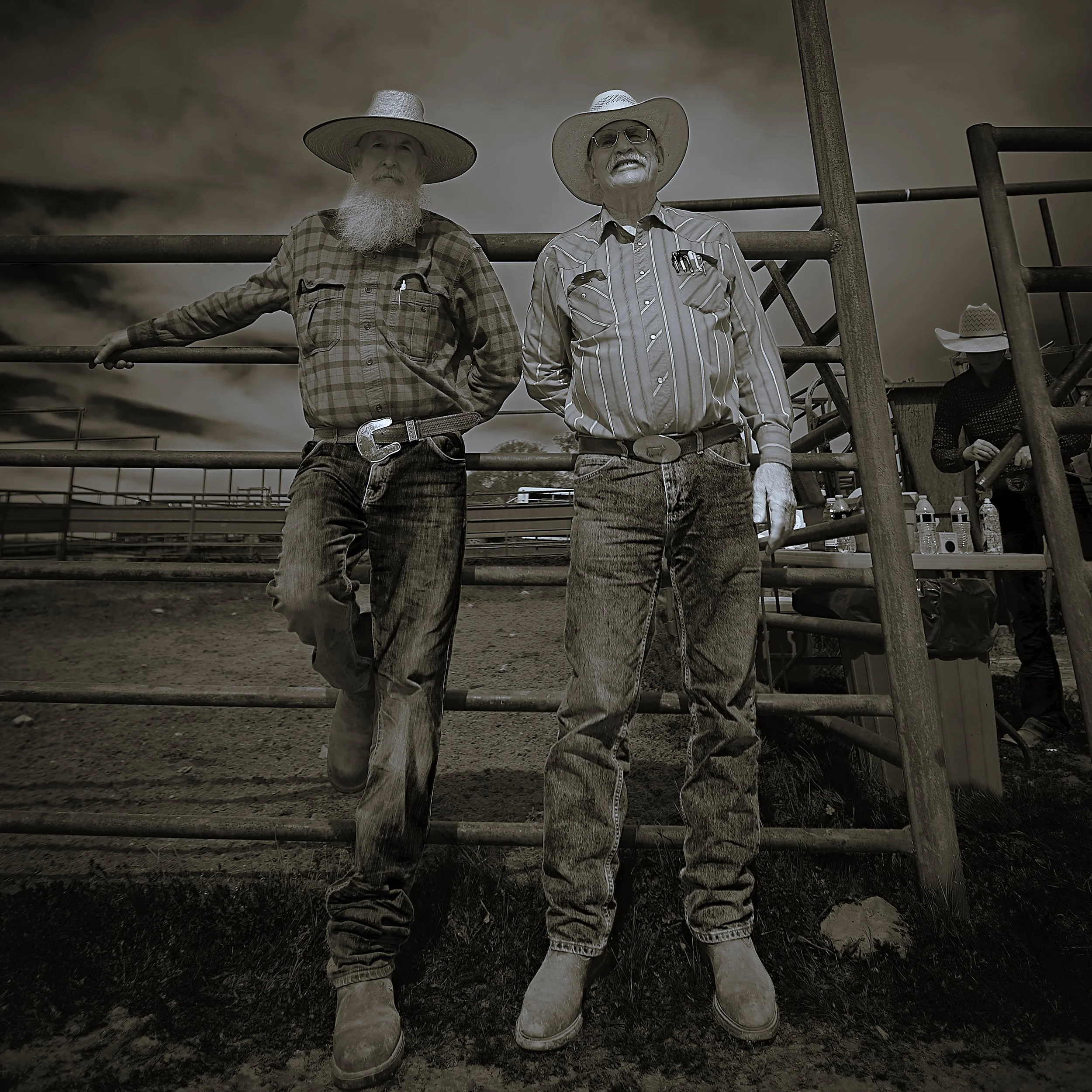
Photo #1 Kevin & Alex Lerma
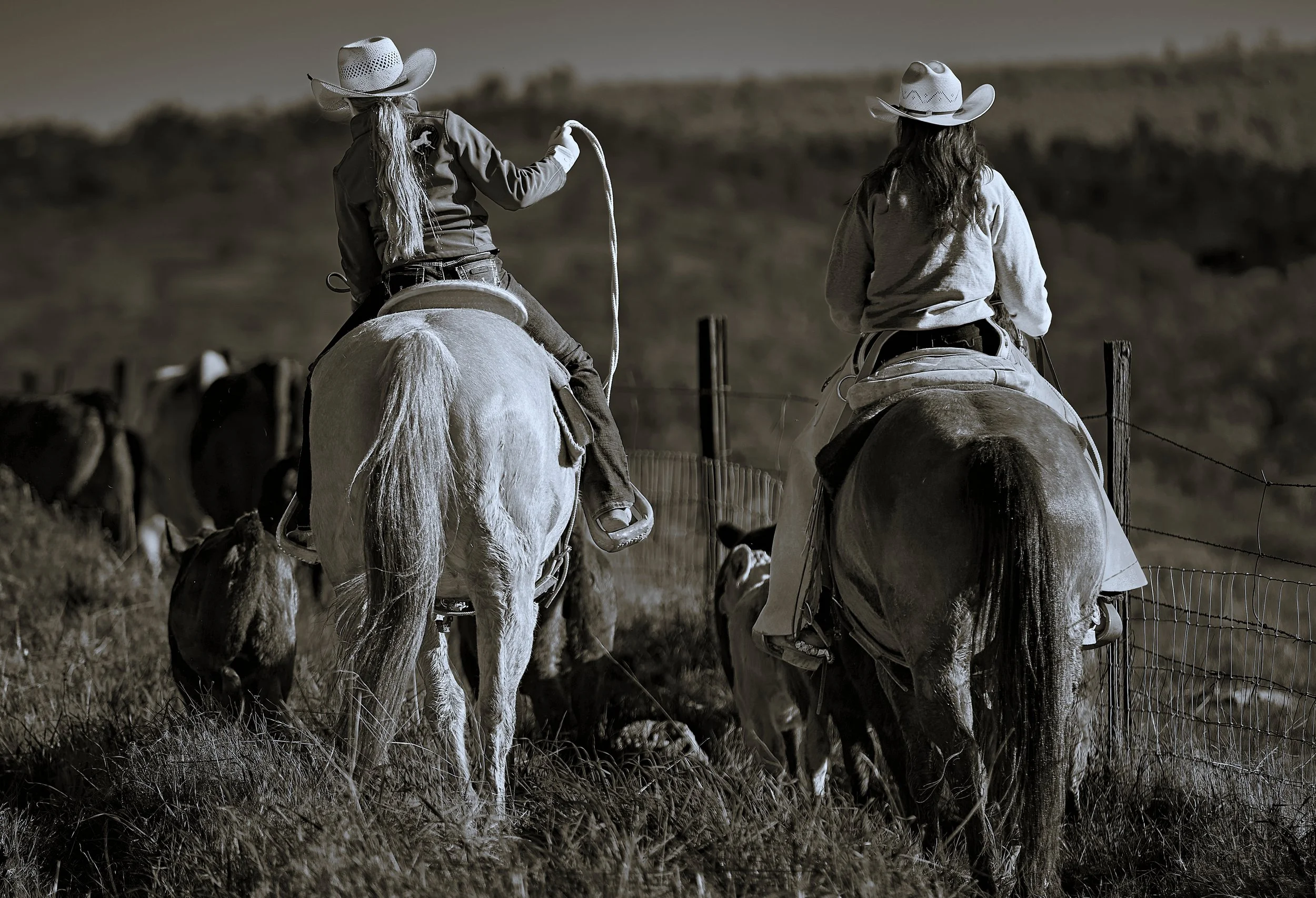
Photo #2 Bonnie & Winnie Frazier
Photo #3 Stephanie Roundy, Tristan Burroughs, Jennifer De Vries & Bonnie Frazier
Photo #4 Tristan Burroughs, Bonnie Frazier, Davy Frazier, Jennifer De Vries,& Stephanie Roundy
Photo #5 Tristan Burroughs, Davy Frazier, Bonnie Frazier, Jennifer De Vries, Stephanie Roundy & Winnie Frazier
Photo #6 Tristan Burroughs, Davy Frazier, Stephanie Roundy, Bonnie Frazier & Jennifer De Vries
Photo #7 Tristan Burroughs, Davy Frazier, Stephanie Roundy, Bonnie Frazier Jennifer De Vries
Photo #8 Jillian Frazier
Photo #9 Ward Burroughs
Photo #10 Lorenzo Larrucea
Photo #11 Branding Crew
Photo #12 Branding Crew
Photo #13 Ward Burroughs
Photo #14 Winnie Frazier & Zane Gookin
Photo #15 Alex Lerma & Tristan Burroughs
Photo #16 Alex Lerma, Davy Frazier & Zane Gookin
Photo #17 Norm Mendenhall & Kevin Lerma
Photo #18 Tristan Burroughs & Kevin Lerma
Photo #19 Tristan Burroughs, Scott Heiny, Kevin Lerma & Alex Lerma
Photo #20 Tristan Burroughs & Norm Mendenhall
Photo #21 Scott Heiny
Photo #22 Scott Heiny, Ward Burroughs, Davy Frazier
Photo #23 Scott Heiny & Norm Mendenhall
Photo #24 Stephanie Roundy
Photo #25 Rien Doornenbal & Scott Heiny
Photo #26 Tristan Burroughs, Kevin Lerma & Jennifer De Vries
Photo #27 Boot
Photo #28 Winnie Frazier
Photo #29 Boot
Photo #30 Overview
Photo #31 Ward Burroughs & Rien Doornenbal
Photo #32 Kevin Lerma
Photo #33 Jillian Frazier, Winnie Frazier, Lorenzo Larrucea & Scott Heiny
Photo #34 Winnie Frazier’s Boot
Photo #35 Alex Lerma
Photo #36 Kevin & Alex Lerma
Photo #37 Scott Heiny, Alex Lerma, Tristan Burroughs & Jennifer DeVries
Photo #38 Ward Burroughs
Photo #39 Ward Burroughs
Photo #40 Ward Burroughs
Photo #41 Tristan Burroughs
Photo #42 Scott Heiny & Ward Burroughs
Photo #43 Lorenzo Larrucea, Winnie Frazier, Jullian Frazier & Tristan Burroughs
Photo #44 Stephanie Roundy
Photo #45 Ward Burroughs, Stephanie Roundy, Winnie Frazier, Davey Frazier, Lorenzo Larrucea & Zane Gookin
Photo #46 Winnie Frazier & Ward Burroughs
Photo #47 Stephanie Roundy
Photo #48 Lorenzo Larrucea, Jennifer De Vries, Alex Lerma & Zane Gookin
Photo #49 Tristan Burroughs
Photo #50 Davey Frazier & Zane Gookin
Photo #51 David Frazier, Zane Gookin & Jillian Frazier
Photo #52 Winnie Frazier & Jennifer De Vries